Watch Fire Erupts Beneath Nose of Etihad Boeing 777 at Delhi Airport
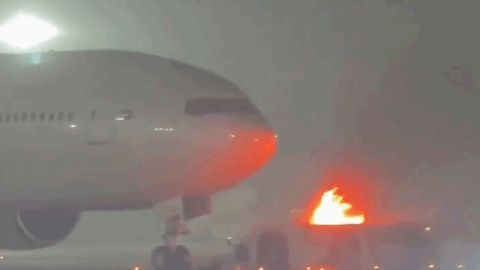
via @justflyingX / X
A Routine Operation Turns Into Alarm
Air travel depends on routine procedures carried out with careful timing and coordination. On March 14, a normal ground operation at Indira Gandhi International Airport in New Delhi briefly turned into an emergency when a support vehicle caught fire beneath a large passenger aircraft. The event drew attention not because of damage or injuries, but because of how close the situation came to becoming serious.
The aircraft involved was an Etihad Airways Boeing 777-300ER preparing for departure during the afternoon. As part of standard airport practice, a pushback tug was connected to the aircraft’s nose landing gear to move it away from the boarding gate before taxiing. During this maneuver, witnesses suddenly noticed thick black smoke rising from the tow vehicle positioned directly under the aircraft’s nose section.
Fire Beneath the Aircraft
Within moments, orange flames appeared from the tug’s engine compartment, creating concern among ground crews and nearby passengers. Pushback tugs are heavy machines designed to move aircraft weighing hundreds of tons, and they operate under intense mechanical stress. Early reports indicated that the fire began inside the vehicle’s mechanical systems rather than the aircraft itself.
Airport emergency teams reacted quickly. Ground staff halted the pushback operation while fire responders rushed to the scene. The aircraft remained stationary as crews worked to extinguish the blaze and secure the surrounding area. Officials later confirmed that the flames never spread to the Boeing 777 and that the aircraft’s structure remained unaffected.
Safety Response at One of the World’s Busiest Airports
Indira Gandhi International Airport handles tens of millions of passengers each year and ranks among the busiest aviation hubs in the world, making rapid incident response essential to maintaining safety and operational flow. The airport’s emergency protocols were activated immediately, demonstrating how ground incidents are managed even before aircraft begin taxi operations.
After the fire was extinguished, the Etihad aircraft was towed back to a parking stand for a full technical inspection. Passengers, flight crew, and ground personnel were reported safe, with no injuries recorded. Airport authorities confirmed that normal apron activity resumed shortly after the area was cleared and inspected.
Understanding Pushback Operations and Risks
Pushback procedures are essential because large aircraft cannot move backward using engine power alone near gates. Specialized vehicles guide aircraft safely into position while minimizing jet blast risks around terminals and equipment. Although incidents involving pushback tugs are uncommon, mechanical faults, overheating components, or electrical failures can occasionally lead to fires under demanding operating conditions.
The March 14 incident serves as a reminder of how closely coordinated airport systems must be. Even routine ground equipment plays a critical role in aviation safety, and swift response by trained crews ensured that a dangerous moment ended without escalation.