

Watch: Iconic Spitfires and C-47 Dakota Take to the Skies for 90th Anniversary
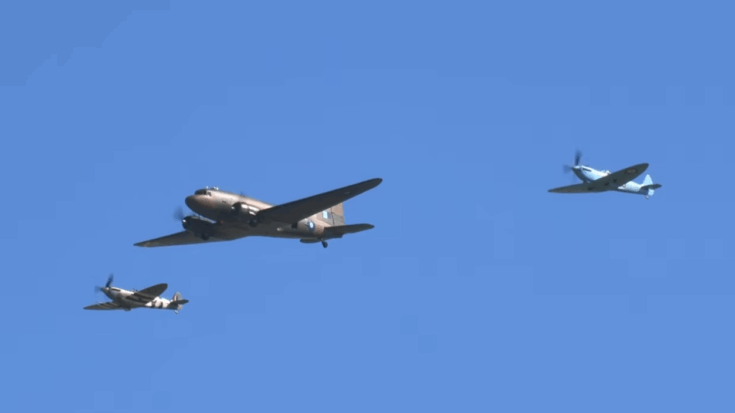
Ted Coningsby / YouTube
Iconic Spitfires and a Dakota Mark Ninety Years of Flight
Few aircraft from the Second World War hold the same place in public memory as the Supermarine Spitfire. Known for its graceful lines and strong performance, it came to symbolize British resistance during the early years of the war. Yet its fame often overshadows other fighters such as the Hawker Hurricane, which entered service earlier, was produced in greater numbers, and accounted for a larger share of enemy aircraft destroyed, especially during the Battle of Britain.
The Spitfire’s story began with uncertainty. Designed by R. J. Mitchell, early efforts such as the Type 224 failed to meet expectations. Progress came with a new approach that introduced the Rolls-Royce Merlin engine and a refined wing shape. When prototype K5054 first flew on 5 March 1936 from Southampton, test pilot Joseph Summers famously advised that little needed changing. That brief flight marked the start of one of the most recognized aircraft designs in aviation history.
Development, Service, and Survival
As war approached, the Spitfire evolved quickly. Early production focused on the Mk I, but continued development brought more powerful engines and improved performance. One example, BS410, reflects this process. Ordered in 1940, it was eventually completed as a later variant equipped with a Merlin 61 engine, showing how wartime needs reshaped production plans. Built at Salisbury and assembled at Chattis Hill, it first flew in October 1942.
BS410 soon joined No. 315 Polish Fighter Squadron at RAF Northolt. Pilots of this unit, many of whom had escaped occupied Europe, played an important role in Allied air operations. The aircraft carried the squadron’s markings and flew dozens of operational sorties. Its service included a public appearance over Wembley Stadium in early 1943, reflecting how these aircraft also served to boost morale on the home front.

Restoration and Modern Flights
After its wartime service, BS410 was lost following a forced landing. For many years, it remained buried until it was recovered decades later. The restoration process took fifteen years, requiring careful reconstruction and engineering work. During this effort, the aircraft was converted into a two-seat training version, allowing new generations of pilots to experience its handling characteristics.
Now registered as G-TCHI, the aircraft continues to fly. In April 2026, it carried out a commemorative series of flights linking locations tied to its history, including RAF Coningsby, RAF Lossiemouth, and Southampton Airport. These journeys retraced parts of Britain’s aviation past while demonstrating that aircraft designed nearly ninety years ago can still operate in the modern world, supported by ongoing preservation and technical care.






