The Jet That Won the Cold War Before It Even Flew
YouTube / Found And Explained
When American jet bombers began appearing at overseas bases in the early 1950s, Soviet planners realized they were facing more than a new aircraft. They were confronting a global strike system. The bomber at the center of that shift was the Boeing B-47 Stratojet, a design that reshaped nuclear strategy before it ever entered full service.
A Radical Break from Propellers
In 1943, the US Army Air Forces began exploring a jet-powered bomber capable of exceeding 600 mph, flying above 40,000 feet, and crossing oceans. Early concepts resembled scaled-down piston bombers with jet engines attached. That changed in 1945 when Boeing engineers examined captured German research on swept wings.

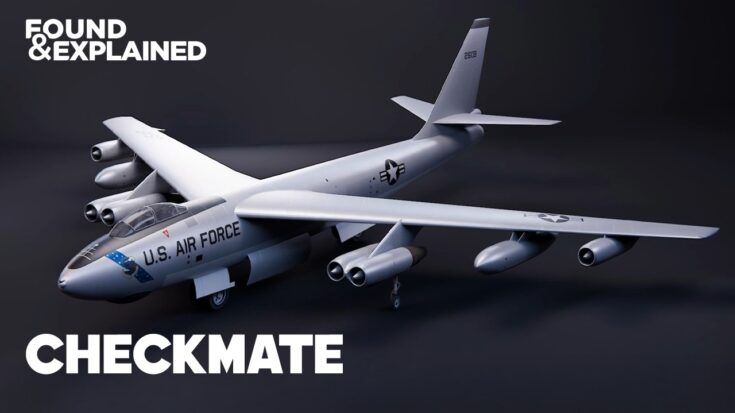
The result was a complete redesign. The B-47 adopted 35 degree swept wings, pod-mounted engines beneath the wings, and a bicycle landing gear arrangement to accommodate its thin airfoil. Its tandem cockpit and three-man crew reflected a focus on speed and aerodynamic efficiency. The configuration looked closer to a fighter than a traditional bomber.
Proving the Concept
The XB-47 first flew on December 17, 1947. Flight testing confirmed exceptional performance. In one transcontinental dash, it averaged 608 mph, faster than many contemporary fighters. Its cruise speed approached 600 mph at altitude, and it could operate above 35,000 feet while carrying early nuclear weapons.

Testing revealed challenges including Dutch roll instability and high-speed pitch-up tendencies. Engineers addressed these issues with yaw dampers and vortex generators. Despite structural fatigue concerns in its thin wings, the Air Force ordered the bomber into production.
Backbone of Strategic Air Command
By the mid-1950s, the B-47 formed the core of the Strategic Air Command nuclear force. From one wing in 1951, the fleet expanded to 28 wings by 1956, totaling 1,285 aircraft in service. Over 2,000 were built.

Bases in England, Morocco, Spain, Alaska, Greenland, and Guam positioned the Stratojet within striking distance of the Soviet Union. Roughly one third of the force remained on alert, armed and ready to launch within minutes. Minimal interval takeoffs sent aircraft down runways seconds apart, each carrying strategic weapons.
Early Soviet interceptors such as the Mikoyan-Gurevich MiG-15 struggled to match the B-47’s speed and altitude. Even when later fighters like the Mikoyan-Gurevich MiG-17 appeared, the Stratojet often retained a performance margin.
The Shift to Low-Level Penetration
By the late 1950s, improved Soviet defenses and surface-to-air missiles reduced the survivability of high-altitude bombing. Crews trained for low-level penetration, using terrain masking to evade radar. This tactic increased structural stress and accident rates, contributing to 203 aircraft losses over the program’s lifetime.

Production ended in 1957. The larger Boeing B-52 Stratofortress gradually assumed the primary deterrent role, while the supersonic Convair B-58 Hustler introduced a different approach to speed-based penetration. The last B-47 bombers left operational service in 1966.
Strategic Impact
The B-47 demonstrated that large swept-wing jet bombers could be built in quantity and deployed worldwide. Its global basing structure, alert posture, and speed forced the Soviet Union to invest heavily in air defense modernization. Long before missiles dominated strategy, the Stratojet defined the nuclear balance.

It did not fire a shot in nuclear war. Its value lay in readiness, reach, and credibility. In that sense, the B-47 shaped the Cold War before it ever had to fight it.