The Best WWII Fighters Ranked by Combat Performance
YouTube / Parry This
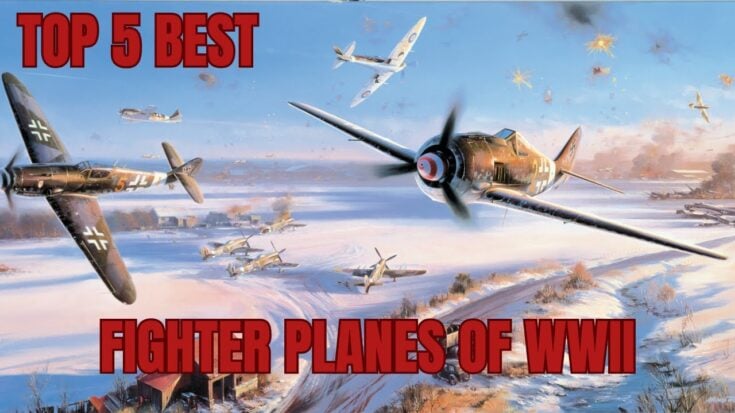
World War II did not produce a single perfect fighter. It produced aircraft built for specific missions, theaters, and phases of the war. When ranking the best, combat performance matters most: speed, climb, altitude capability, range, firepower, survivability, and the ability to influence real battles. Judged by those standards, five aircraft stand above the rest.
5. Focke-Wulf Fw 190
The Fw 190 was one of the most practical and hard-hitting fighters of the war. Early variants such as the A-2 reached roughly 410 mph and carried heavy cannon armament that made them formidable bomber interceptors. Allied pilots in 1941 and 1942 encountered an aircraft that rolled quickly, accelerated well, and could end an engagement in seconds.

The later Fw 190D-9 pushed performance further, reaching about 426 mph with a ceiling near 40,000 feet. Armed with 20 mm cannons and 13 mm machine guns, it remained dangerous through 1945. Germany’s deteriorating training and fuel situation limited its overall impact, but as a fighting machine the Fw 190 delivered speed, firepower, and durability.
4. Messerschmitt Bf 109
The Bf 109 was Germany’s primary single-engine fighter from the opening campaigns to the defense of the Reich. Around 35,000 were built, ensuring constant presence in decisive air battles.

The late-war Bf 109K reached approximately 452 mph with a ceiling near 41,000 feet. Those figures placed it among the fastest piston fighters of the war. However, later variants demanded more from their pilots, particularly as Germany’s training pipeline weakened. Its speed and production scale secure its position, though operational strain kept it from ranking higher.
3. Supermarine Spitfire Mk IX
The Spitfire Mk IX restored balance in 1942 after the arrival of the Fw 190. Capable of about 416 mph, climbing at roughly 3,200 feet per minute, and operating up to 42,500 feet, it matched German fighters at critical altitudes.

Armed with two 20 mm cannons and .50 caliber machine guns, it also carried bombs when required. Its limitation was range, which constrained long-distance escort missions. Its strength lay in adaptability and sustained frontline relevance.
2. Grumman F6F Hellcat
The F6F Hellcat defined carrier air superiority in the Pacific. In roughly two years of combat, it accounted for over 5,000 enemy aircraft, often cited with a 19 to 1 kill ratio.

The F6F-5 reached about 388 mph and had a ferry range near 1,530 miles. Its six .50 caliber machine guns provided consistent firepower. Rugged construction and forgiving handling allowed naval aviators to succeed across thousands of miles of ocean warfare.
1. North American P-51D Mustang
The P-51D Mustang combined speed, altitude performance, firepower, and range in one airframe. It reached approximately 437 mph, operated near 41,900 feet, and offered combat ranges around 1,000 miles with drop tanks.

Its six .50 caliber machine guns and ability to carry bombs and rockets expanded its role beyond escort. The Mustang enabled deep penetration missions over Germany, protecting bombers to their targets and back. Its range solved a central strategic problem in the European air war, making it the most complete fighter package of World War II.