How the US Pulled Off a 170-Aircraft Rescue Deep Inside Iran
The White House has released new details about the rescue of the two-man crew of DUDE 44, the F-15E Strike Eagle shot down over Iran on April 3, describing a pair of back-to-back operations involving more than 170 aircraft, CIA surveillance technology, a deliberate deception campaign, and a landing on a muddy Iranian farm that nearly stranded the rescue force itself.
President Trump, speaking alongside Defense Secretary Pete Hegseth, Chairman of the Joint Chiefs General Dan Caine, and CIA Director John Ratcliffe, called it one of the largest and most complex combat search and rescue missions ever attempted.
How the Jet Went Down
The F-15E, flying with the callsign DUDE 44, was struck in the early morning hours of April 3 local time. Trump said the Iranians got lucky with a shoulder-fired, heat-seeking missile, a reference to man-portable air defense systems, known as MANPADS. Unlike larger, fixed air defense installations that can be identified and targeted through suppression campaigns, MANPADS are small enough to be hidden almost anywhere, making them a persistent threat even as broader Iranian air defense networks have been degraded.

Both the pilot, designated DUDE 44 Alpha, and the weapons systems officer, DUDE 44 Bravo, ejected safely. Given the speed at which the aircraft was traveling, the two crew members came down miles apart from each other.
The First Mission: 21 Aircraft in Daylight
The Joint Personnel Recovery Center declared an isolated personnel recovery event at 4:40 a.m. local time. Within hours, a combat search and rescue task force of 21 aircraft launched into Iranian airspace in broad daylight, a significant risk that Trump acknowledged directly. “I ordered the US Armed Forces to do whatever was necessary,” he said. “A risky decision because we could have ended up with 100 dead.”

The force included A-10C Thunderbolt IIs flying in the Sandy role, providing close air support, alongside HC-130J Combat King IIs and HH-60W Jolly Green II rescue helicopters. Footage that spread on social media shortly after the mission, confirmed as authentic by General Caine, showed an HC-130J refueling two HH-60Ws in flight over Iran, allowing the helicopters to push deeper into the objective area.
🇺🇸🇮🇷 An American A-10 Atack aircraft, flying over southern Iran, joined a search-and-rescue support operation for pilots. pic.twitter.com/s4jItfppkA
— Visioner (@visionergeo) April 3, 2026
The A-10s bore the brunt of the fighting. Caine described them as violently suppressing Iranian forces to keep them away from the downed pilot. One A-10, the aircraft primarily responsible for communicating with the pilot on the ground, was struck by enemy fire during the engagement. The pilot kept the aircraft in the fight, but on the return leg determined it was not landable and ejected safely over friendly territory. The HH-60 helicopters also came under sustained fire. Caine said the trailing aircraft was engaged by what he described as essentially every person in Iran with a small arms weapon, sustaining multiple hits, though crew injuries were minor.
The pilot was successfully recovered. The WSO was still missing.
36 Hours Behind Enemy Lines
The second rescue was a different order of magnitude entirely. The WSO, identified as a colonel, had been badly injured in the ejection and came down in terrain crawling with Islamic Revolutionary Guard Corps units and local militias. Applying survival, evasion, resistance, and escape training, he moved away from the crash site, climbed into mountainous terrain, and found a position where he could conceal himself and eventually make contact with US forces.
CIA Director Ratcliffe described the intelligence challenge of locating him as finding a single grain of sand in a desert. The agency used what he called exquisite technologies that no other intelligence service in the world possesses, declining to elaborate further given the covert authorities involved. Trump was less circumspect, describing a camera that surveilled the area for 45 minutes until the WSO was positively identified.
Search and rescue by locals in southern Iran trying to locate the American F-15 crew members in order to secure the 10 billion tomans ($7,000) reward offered by merchants in Kohgiluyeh and Boyer-Ahmad province pic.twitter.com/4irfycvzB3
— Fazel Hawramy (@FazelHawramy) April 3, 2026
Meanwhile, Iranian authorities had launched a massive manhunt. Trump said thousands of military personnel, irregular forces, and civilians were combing the terrain, with incentives offered for the airman’s capture. To buy time, the US ran a coordinated deception campaign, deliberately altering aircraft movements and striking seven different locations to mislead Iranian search teams about where the WSO actually was.
The Second Mission: 155 Aircraft
Once the WSO’s position was confirmed, the operation scaled up dramatically. The second rescue mission alone involved 155 aircraft, including four bombers, 64 fighters, 48 aerial refueling tankers, and 13 dedicated rescue platforms. Combined with the first mission, the total force exceeded 170 aircraft.
U.S. C‑130s fly low over southern Iran, evading radar and air defenses during a risky rescue mission for a downed F‑15E. pic.twitter.com/kjlQe2RH0Z
— Open Source Intel (@Osint613) April 3, 2026
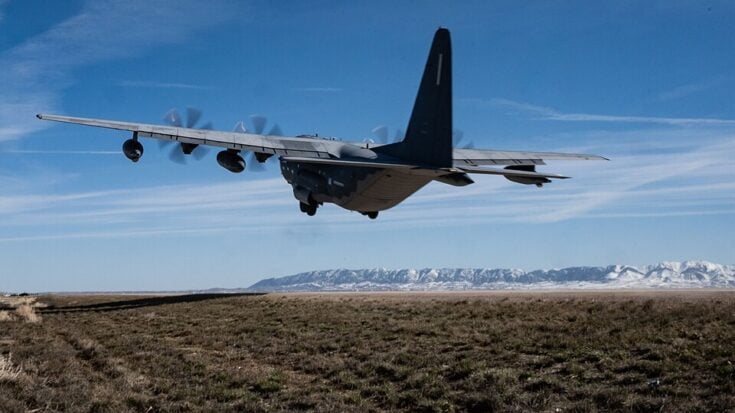
The extraction force landed on improvised terrain. Two MC-130 Commando II aircraft put down on what Trump described as a farm, not a runway. Three A/MH-6 Little Bird helicopters were unloaded and immediately flew toward the objective to retrieve the WSO. The extraction succeeded, but when the MC-130s attempted to depart, they became bogged down in wet, unstable ground and could not take off.
Smaller, lighter aircraft were brought in as replacements, believed to be C-295Ws operated by the Air Force Special Operations Command’s secretive 427th Special Operations Squadron, based on video footage of the aircraft flying at low altitude inside Iran. All personnel were evacuated. The stranded MC-130s and Little Birds were then destroyed on site. “We blew them up to smithereens,” Trump said. “We didn’t want anybody examining our equipment.”
BREAKING: Photos confirm at least two USAF C-130 Hercules and multiple MH-6M Little Bird helicopters were destroyed at a forward operations base in southern Iran after last night’s F-15E rescue operation.
The aircraft were destroyed by US forces to prevent capture after the WSO… pic.twitter.com/b6oBexBdAL
— The Hormuz Letter (@HormuzLetter) April 5, 2026
Despite the complications, both crew members were recovered. Ratcliffe called it a no-fail mission, crediting the integration of intelligence, airpower, and special operations under extreme conditions. For Trump, the message was straightforward. “In the United States military, we leave no American behind.”