

Watch: First Moments as Recovery Team Reaches Artemis II Crew After Splashdown
@astro_reid / X
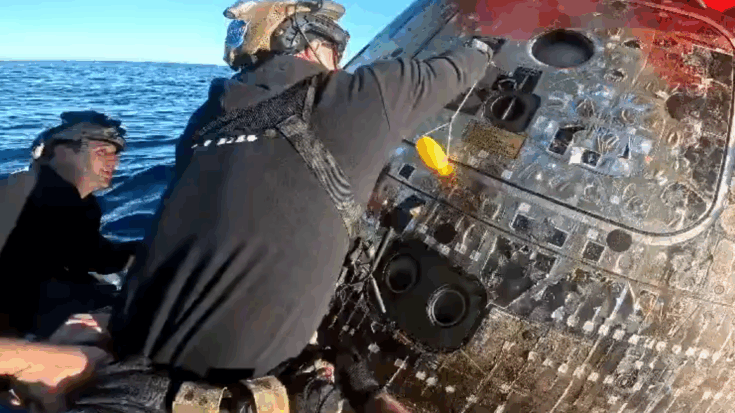
The return of a crew from deep space has always been a rare and carefully managed event. On April 15, 2026, that tradition continued as astronauts from NASA’s Artemis II mission completed a ten-day voyage and reentered Earth’s atmosphere, ending with a controlled splashdown in the Pacific Ocean. Newly released footage captures the first moments of recovery, offering a clear view of the procedures that follow a mission of such scale.
The Artemis II flight marked a major step in modern space exploration. It was the first time since the final Apollo missions of the early 1970s that a crew had traveled around the Moon and safely returned. The operation that followed reentry reflects decades of experience, refined since the era of the Apollo program.
The Return Through Fire and Ocean
As the spacecraft descended, it endured extreme heat generated by atmospheric reentry. Temperatures on the capsule’s heat shield reached approximately 2,800 degrees Celsius, a level necessary to slow the vehicle from orbital speeds. The scorched exterior seen in the recovery footage serves as evidence of this intense phase, a process that has remained largely unchanged since early crewed missions.
After parachutes deployed and stabilized the capsule, it touched down in open water. The ocean landing method, first used extensively during the Apollo era, remains effective for missions returning from deep space due to its flexibility and safety margin. Recovery teams had already been positioned in the area, tracking the capsule’s descent with precision.
Recovery Teams Move In
Within minutes of splashdown, specialized U.S. Navy divers approached the floating spacecraft. Their initial task was to secure the capsule and ensure it remained stable in the water. This step is critical, as ocean swells can shift the vehicle and create risks for both crew and recovery personnel.
Once stability was confirmed, the divers prepared the hatch for opening. The footage shows a coordinated effort, with multiple team members working in close proximity to the capsule. This phase mirrors procedures developed over decades, combining military discipline with spaceflight requirements.
Extraction and Immediate Care
After the hatch was opened, astronauts were carefully assisted out of the spacecraft. Despite being in good condition, crews returning from space often experience temporary physical effects, including balance issues caused by readjusting to gravity. For this reason, recovery teams handle them with caution.
The astronauts were then lifted by helicopter and transported to the nearby amphibious transport dock, the USS John P. Murtha (LPD-26). This vessel served as the primary recovery ship, equipped with medical facilities and personnel trained to assess returning space crews.
Onboard medical teams conducted immediate evaluations, checking vital signs and ensuring the astronauts were stable after their journey. Such assessments are standard practice, dating back to earlier missions when the effects of space travel were less understood.






