WATCH: B-1B Lancer Gets Loaded With Bunker Busters
Credits to Richard Gaisford
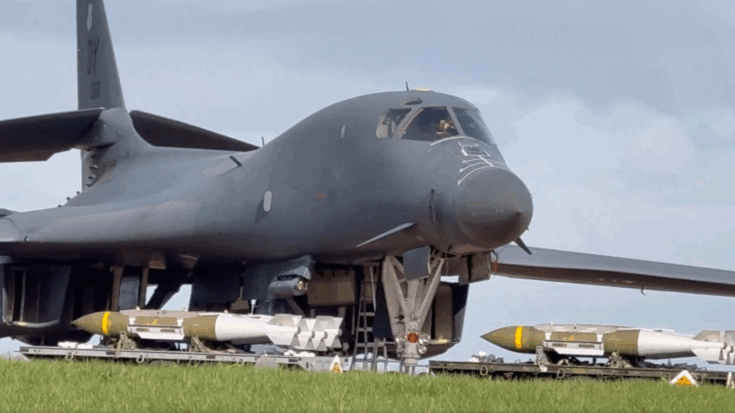
Footage from RAF Fairford shows American B-1B Lancers being prepared for strike missions against Iran with a weapons loadout that tells a specific story about how the air campaign has evolved. Alongside the AGM-158 JASSM cruise missiles that have characterized earlier B-1 operations, ground crews are loading GBU-31 Joint Direct Attack Munitions fitted with BLU-109 2,000-pound bunker-buster warheads. The revolving weapons rack was extracted from at least one aircraft’s bay during the preparations.

What the Weapons Change Means
The shift from cruise missiles to direct-delivery JDAMs is not cosmetic. Cruise missiles allow aircraft to strike targets while remaining well outside defended airspace. JDAMs require the aircraft to fly over or near the target. That change in tactics reflects a change in conditions: air defenses in western Iran have been degraded enough that B-1s and B-52s can now operate with greater freedom over certain target sets without the standoff buffer that cruise missiles provide.
Missiles delivery systems are being removed from the B1 Lancers at RAF Fairford this afternoon, to be replaced by JDAM bombs. For those asking, the US Airforce has positioned these aircraft close to the fence in full view of media. @AJENews pic.twitter.com/fWtDRfV5g4
— Richard Gaisford (@richardgaisford) March 11, 2026
The practical effect is significant. A B-1B carrying a full internal payload of JDAMs can deliver a concentrated assault on a large target area in a single pass. Bunker-buster variants add the ability to strike hardened underground facilities that cruise missiles cannot reliably defeat. Until recently, that capability had been limited to B-2 Spirit sorties, which used stealth to penetrate defended airspace and deliver GBU-57 Massive Ordnance Penetrators against deeply buried sites. Opening similar target sets to forward-deployed B-1s changes the pace and volume of the campaign considerably.
The Force at Fairford Has Grown
The bomber presence at Fairford has expanded substantially. The base held nine American bombers at the start of this week, three B-52s and six B-1Bs. That number has since grown to 15, with the B-1 contingent doubling to 12 aircraft. RAF Fairford’s runway, at just under three kilometers, is one of the longest in the United Kingdom and one of the few European bases certified to operate aircraft of this size and weight class.
US Airforce ground crew work under hatches of a B1 Lancer at RAF Fairford today. What appear to be cruise missiles sit by the warplane. Three B1 bombers returned this morning, on what is believed to be the first attack on Iran from a British base during this conflict. @AJENews pic.twitter.com/80YkxHL5rT
— Richard Gaisford (@richardgaisford) March 11, 2026
British Prime Minister Keir Starmer initially declined to grant the United States access to UK bases for operations against Iran, which created friction with the Trump administration. He reversed that position at the beginning of March, authorizing use of both Fairford and Diego Garcia for the specific purpose of destroying Iranian missile infrastructure. The Ministry of Defence described the authorization as covering defensive operations against Iranian missile sites at source.
Likely Targets and Remaining Limits
The B-1s will almost certainly operate over western Iran, where the two-week focus on air defense suppression has created the most permissive environment for non-stealth bombers. Eastern Iran has seen significantly fewer strikes and likely remains too risky for B-1 and B-52 operations without additional suppression work. A Pentagon map released covering the first ten days of the campaign illustrates the geographic concentration of strikes in the western part of the country.

Likely target categories for direct JDAM delivery include weapons production and development facilities, command and control bunkers, nuclear program infrastructure, and the entrances to Iran’s underground missile storage complexes. Sealing those tunnel entrances with repeated bunker-buster strikes would keep stored weapons entombed without requiring the destruction of the weapons themselves.