

US Forces Destroy 2 C-130 Transport Planes During Recovery Mission
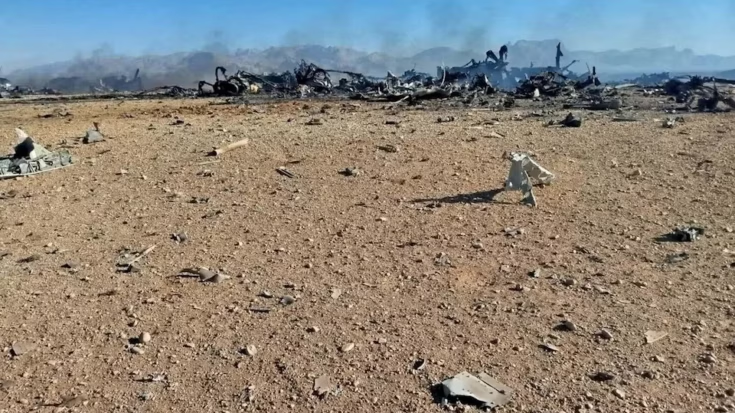
In the closing moments of a massive operation to rescue a downed US Air Force officer from deep inside Iran, American forces were forced to destroy their own aircraft on Iranian soil rather than let them fall into enemy hands, adding an unexpected and costly footnote to an already extraordinary mission.
Unable to get the aircraft airborne, commanders made the call to blow them up on the spot. Three replacement aircraft were then flown in to extract all US personnel.

Iran’s military later claimed that two US C-130 transport planes and two Black Hawk helicopters were destroyed during the operation, and that a “deception and escape mission at an abandoned airport in southern Isfahan had been completely foiled.” Satellite imagery and photos appeared to show smoldering aircraft wreckage in a mountainous area roughly 30 miles southeast of Isfahan.
A Mission Within a Mission
The destruction of the transport planes was the final complication in what a senior US military official described as one of the most complex rescue operations in the history of American special operations. The mission had already involved hundreds of troops, dozens of warplanes and helicopters, CIA intelligence support, and a deception campaign run inside Iran to mislead Iranian forces about the airman’s location.

After Navy SEAL Team 6 extracted the injured colonel from a mountain crevice where he had been hiding for more than 24 hours, US forces still had to get everyone out of Iranian territory. When the transport planes tasked with that extraction became inoperable at the remote base, leaving them behind intact was not an option. Military aircraft are packed with sensitive technology, classified communications equipment, and intelligence systems that could provide significant value to an adversary.
Destroying aircraft to prevent capture is a well-established protocol in US military operations, but carrying it out on the ground inside a hostile nation, under pressure, with Iranian forces in the area, added a layer of risk that commanders had not anticipated when the operation began.






