10 Brilliant Aircraft That Came Too Late To Make A Difference
YouTube / Vintage Warbirds
World War II aviation advanced at a pace few engineers could control. Several aircraft reached maturity only after the strategic situation had already shifted beyond recovery. These designs had the performance, firepower, and engineering needed to influence the air war, but timing denied them that role.
1. Dornier Do 335 Pfeil

The Do 335 used a push-pull engine layout that minimized drag while delivering exceptional speed, approaching 470 mph. It entered limited service in late 1944, when Germany lacked fuel, trained pilots, and intact factories. Production remained minimal, preventing its use as a bomber interceptor in strength.
2. Heinkel He 162

Designed for rapid construction, the He 162 was a lightweight jet with strong performance potential. It arrived in 1945 amid severe pilot shortages and minimal training time. Structural issues and inexperience caused heavy losses before combat could prove its value.
3. Focke Wulf Ta 152H

Built for high altitude interception, the Ta 152H featured long wings, cockpit pressurization, and a powerful Jumo engine. Only a small number reached operational units in 1945. Germany’s air defense system had already collapsed by that point.
4. Kyushu J7W Shinden

The J7W Shinden used a canard configuration optimized for intercepting B-29 bombers. Test flights in 1945 showed promising climb and stability. Japan’s material shortages and surrender ended the program before weapons testing and production began.
5. Mitsubishi A7M Reppu

The A7M was intended as a successor to the A6M Zero, offering greater speed, durability, and climb. Persistent engine delays and factory damage pushed development into late 1944. By then, Japan lacked the resources to bring it into service.
6. Kawasaki Ki 84 Hayate

The Ki 84 offered competitive speed and heavy armament comparable to late war Allied fighters. Early examples performed well, but declining material quality and engine reliability degraded later production. These issues emerged as Japan’s industry deteriorated.
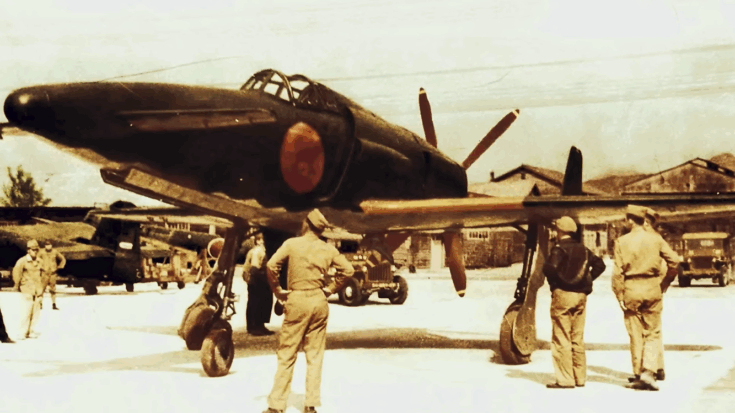
7. Kawasaki Ki 100

Created by fitting a radial engine to the Ki 61 airframe, the Ki 100 delivered excellent handling and reliability. It reached combat units in 1945 in limited numbers. Production came too late to influence Japan’s defensive battles.
8. Hawker Tempest II and Hawker Fury

The Tempest II was optimized for low altitude combat with strong speed and roll performance. It became operational after the Luftwaffe had largely ceased effective resistance. The Fury, its refined successor, never entered wartime service.
9. de Havilland Hornet

Derived from Mosquito experience, the Hornet combined long range with high speed near 470 mph. Intended for Pacific operations, it became operational only after Japan’s surrender. No combat deployment occurred.
10. Grumman F8F Bearcat

Designed for carrier operations, the Bearcat emphasized climb rate, agility, and compact size. It entered fleet service as the war ended in 1945. Its performance remained largely untested in combat conditions.