

WWII P-51 Fighter Pilot Meets F-16 Fighter Pilot
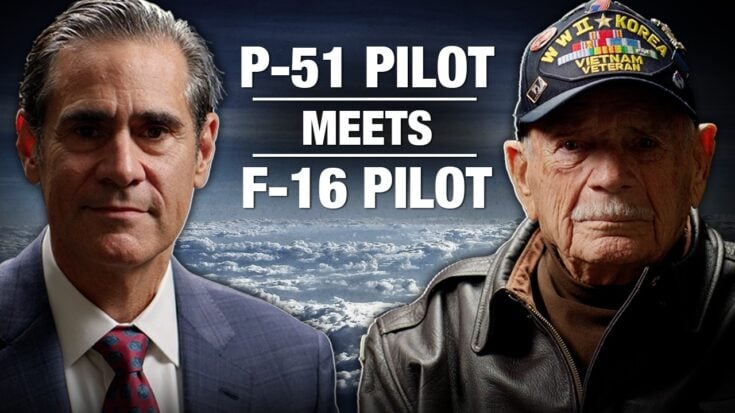
YouTube / American Veterans Center
Two American fighter pilots, separated by four decades, compared their paths through the US Air Force and the aircraft that defined their careers. Joe Peterburs flew the P-51 Mustang over Germany during World War II. Marc Sasseville later flew the F-16 Fighting Falcon during the Cold War and into the modern era. Their discussion showed how fighter aviation changed while the responsibilities placed on pilots remained consistent.
Entering the Cockpit
Joe Peterburs entered the Army Air Forces directly from civilian life after Pearl Harbor. He had no prior flight experience when training began. His path moved through multiple bases, relied heavily on civilian instructors, and carried high washout rates. By his late teens, he was a commissioned fighter pilot preparing for combat in Europe.

Marc Sasseville followed a structured peacetime system. He progressed through a standardized training pipeline that emphasized evaluation at every stage. Early instruction focused on formation flying, instrument discipline, and radio procedures before he ever reached a frontline squadron.

Flying the Aircraft
The P-51 required constant physical involvement. Peterburs relied on stick pressure, engine sound, and visual cues to manage the aircraft. Navigation depended on dead reckoning and landmarks. Air combat demanded precise gunnery, close visual range, and constant scanning for threats.

The F-16 reduced much of that physical feedback. Fly by wire controls filtered pilot input through flight computers. Sasseville relied on radar, data links, and advanced avionics to maintain situational awareness. Combat emphasized timing, geometry, and systems coordination rather than manual marksmanship.
Combat Environment
World War II missions placed Peterburs among massive bomber formations operating deep over enemy territory. Escort flights lasted for hours and faced heavy flak, debris, and coordinated interceptor attacks. Once released from escort duty, pilots often had broad discretion to engage targets of opportunity.

Sasseville operated in a tightly managed battlespace. Missions were planned in detail before takeoff, including targets, alternates, and rules of engagement. Precision guided weapons replaced strafing runs, and success depended on coordination within a networked force.
Risk and Survival
Peterburs described combat as immediate and chaotic. Engagements closed rapidly, often at combined speeds approaching 900 mph. Survival depended on formation discipline, instinct, and luck.
Sasseville faced different dangers. Threats included surface to air missiles, electronic warfare, and information saturation. Survival depended on systems awareness, communication, and strict procedural discipline.
What Stayed the Same
Both men entered combat in their early twenties. Both trusted their training and their aircraft. Both described a strong sense of responsibility to their wingmen and units. Despite dramatic changes in technology, the weight carried by a single pilot in a single cockpit remained unchanged.

Their exchange showed how fighter aviation evolved from visual combat and manual skill to sensor driven warfare and data integration. It also confirmed that discipline, confidence, and commitment remained constant across generations of American fighter pilots.







