

Could One F-15 Fighter Have Changed Pearl Harbor
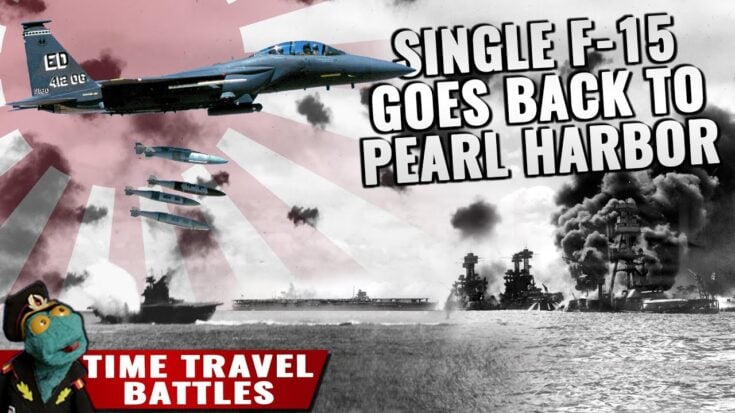
YouTube / Binkov's Battlegrounds
A Moment Frozen in Time
December 7, 1941 marked a turning point in American history. Japanese carrier aircraft struck Pearl Harbor with near total surprise, crippling the US Pacific Fleet and killing more than 2,400 Americans.

The success of the attack rested on timing, secrecy, and the absence of warning. Now imagine a different variable entering that morning. A single modern F-15 Eagle arrives minutes before the first bombs fall.
The Limits of a Fighter Intercept
If the F-15 appeared over Oahu just before the attack, with no opportunity to warn anyone, its immediate value would be limited. Armed as a fighter, the Eagle could engage incoming Japanese aircraft using modern air to air missiles. Depending on the variant, it could destroy roughly eight to fifteen planes in a matter of minutes. Mitsubishi Zeros and Japanese bombers had no radar warning receivers and no defense against beyond visual range attacks.

Once its missiles were expended, the F-15 would rely on its 20 mm cannon. Gun attacks would require careful hit and run passes to preserve speed and avoid becoming vulnerable to escorting fighters. Even with perfect execution, the total number of Japanese aircraft destroyed might reach twenty.
That level of attrition would be noticeable but not decisive. The first wave alone consisted of more than 180 aircraft, and the attack plan concentrated firepower on specific ships. Battleships such as Arizona, Oklahoma, and West Virginia would likely still be hit. As a fighter, the F-15 could disrupt part of one formation, but it could not stop the attack.
A Strike Against the Carriers
The outcome changes if the F-15 arrives configured for strike rather than air combat. Flying north at cruise speed, the Eagle could reach the Japanese carrier force in under thirty minutes. In 1941, the Japanese fleet had no radar capable of detecting a high altitude aircraft at long range. An F-15 flying above 30,000 feet would be effectively invisible and unreachable.

Modern sensors would allow the pilot to identify individual carriers from well over one hundred miles away. With a heavy bomb load, the F-15 could attack all six fleet carriers that launched the Pearl Harbor strike.
Weapons That Change the Equation
Using smaller precision weapons such as StormBreaker bombs, the Eagle could potentially score multiple hits on each carrier, damaging flight decks and hangars. That alone would strand hundreds of Japanese aircraft with nowhere to land. Heavier options, such as 2,000 pound laser guided bombs, would be even more destructive. Dropped from high altitude, these weapons could penetrate deep into lightly armored carriers and cause catastrophic flooding.

Unlike at Midway, where Japanese carriers were sunk by multiple lighter bombs dropped from dive bombers, a single modern bomb might be enough to disable or even sink a carrier outright.
A Different Pacific War
If most of Japan’s carrier force were destroyed north of Oahu, the strategic balance would shift instantly. The Japanese Navy would lose its core striking power, along with hundreds of aircraft and experienced aircrews. Pearl Harbor might still burn, but the Pacific War would unfold very differently. Coral Sea and Midway would never occur. Japan’s ability to project power would collapse within months.

One fighter could not stop Pearl Harbor as it happened. But aimed at the source of the attack, it could have ended the carrier war before it truly began.







