

The Most Modified F-15 Ever Flown
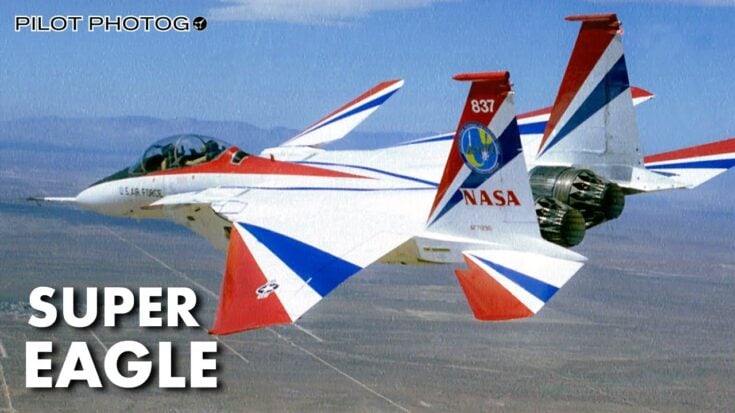
YouTube / PilotPhotog
An Eagle Built for More Than Combat
In 1973, one of the earliest F-15 Eagles rolled off the McDonnell Douglas production line with a future no one could have predicted. Serial number 71-0290 was the sixth F-15 ever built and the first two-seat version of the aircraft, originally designated TF-15.

While intended as a trainer, the aircraft quickly became something far more important. Over the next three and a half decades, it evolved into one of the most heavily modified and scientifically valuable fighter aircraft ever flown.
From Trainer to Strike Eagle Test Bed
Early in its career, 71-0290 was used to support development of the F-15E Strike Eagle. As the Air Force evaluated options under the Enhanced Tactical Fighter program, this aircraft helped test systems and concepts that would later define the Strike Eagle’s deep strike and ground attack role.

Its reliability and flexible airframe made it an ideal platform for experimentation well beyond its original purpose.
Pushing the Limits With STOL and Thrust Vectoring
The aircraft’s most radical transformation came during the STOL MTD program, Short Takeoff and Landing Maneuver Technology Demonstrator. Engineers fitted the Eagle with forward canards, derived from F-18 stabilators, and two dimensional thrust vectoring nozzles. The goal focused on improving operations from damaged or wet runways, a serious concern during Cold War planning.

The results were dramatic. The modified F-15 achieved a 25 percent reduction in takeoff distance, landed in just 1,650 feet instead of the standard 7,500, and demonstrated controlled flight at angles of attack approaching 85 degrees. It could even decelerate rapidly in flight using thrust reversers, a capability unheard of for fighters at the time.
NASA’s Aircraft 837
In 1993, the aircraft transferred to NASA and received a new identity as NF-15B number 837. Under NASA, it became the centerpiece of multiple advanced research programs. The ACTIVE program tested three dimensional thrust vectoring and advanced flight control software, achieving supersonic yaw vectoring and improved efficiency at high speed without increasing engine power.

Later projects explored adaptive neural network flight controls, space based communications, engine stall prevention systems, and methods for reducing sonic boom noise. In several cases, 837 served as the first aircraft to prove concepts that would later influence both military aviation and future civilian designs.
A Career Unlike Any Other Eagle
Aircraft 71-0290 flew its final mission on January 30, 2009, closing a career that spanned 35 years and more than a dozen major research programs. It helped shape the Strike Eagle, advanced thrust vectoring technology, and proved self adjusting flight control systems long before they became standard.

Among all F-15s ever built, none served more roles or contributed more to aviation research. Aircraft 837 was not just an Eagle. It was a flying laboratory that quietly reshaped modern air combat and flight science.







