Why the F-35B Has a Flap Behind the Cockpit
YouTube / Fluctus
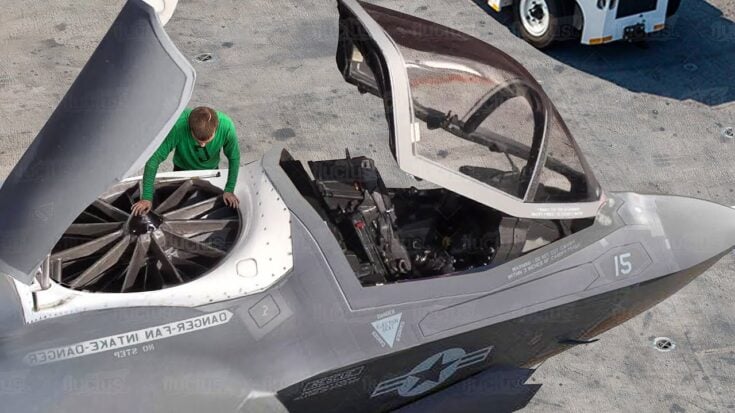
The Lockheed Martin F-35B Lightning II is the only variant of the F-35 family built to take off from short decks and land vertically. A noticeable feature sets it apart: a large door mounted behind the cockpit that opens during vertical operations. That panel is central to how the aircraft hovers.

Unlike the F-35A or the F-35C, the B model was engineered for short takeoff and vertical landing operations. This allows it to operate from amphibious assault ships and forward bases where traditional runways are unavailable.
The Lift Fan System
Behind the cockpit sits a vertically mounted lift fan. In conventional flight, it remains disengaged and sealed within the fuselage to preserve the aircraft’s low observable profile. When the pilot selects STOVL mode, a driveshaft connects the fan to the main engine through a clutch system.

As the upper door opens, air flows into the fan from above the aircraft. The fan then pushes that air downward through a nozzle beneath the fuselage, generating vertical thrust at the front of the jet. Without that airflow, vertical lift would not be possible.
Four-Point Lift Control
Hovering requires more than a single fan. The rear exhaust nozzle rotates downward to vector engine thrust. The lift fan produces upward force near the center of gravity. Roll control nozzles in the wings provide lateral stability.

Together, these components create a balanced four point lift system. This allows the aircraft to hover steadily, descend vertically, or perform a short rolling takeoff from a confined deck.
Why the Intake Is on Top
The lift fan draws air from the upper fuselage because that airflow is cleaner and less disturbed than air beneath the aircraft. During vertical landing, hot exhaust gases circulate below. Pulling intake air from above reduces the risk of hot gas re-circulation and maintains lift efficiency.

The fan’s position just behind the cockpit also aligns closely with the center of gravity. This placement improves stability during vertical operations.