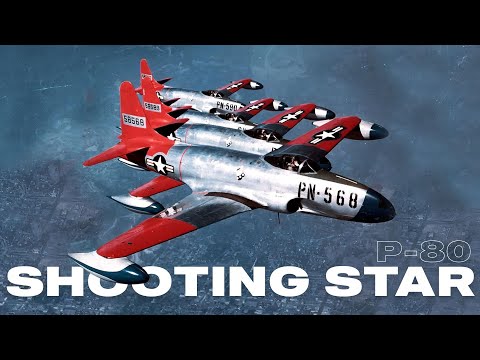
How Good Was the P-80 Shooting Star?
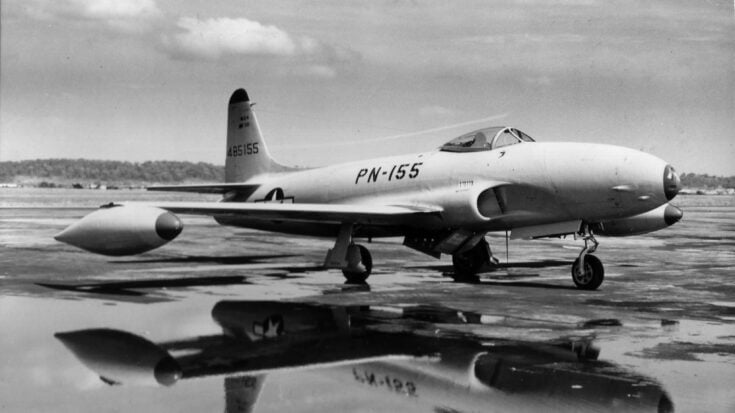
YouTube / Australian Military Aviation History
When people think of World War II jets, the conversation usually turns to the German Me 262 or Britain’s Gloster Meteor. Rarely does America’s first operational jet fighter take center stage.
Yet Lockheed’s P-80 Shooting Star quietly marked the United States’ leap into the jet age – and its performance was more impressive than its limited WWII record suggests!

So how good was the P-80 Shooting Star, really?
Built at Breakneck Speed
By 1943, the U.S. Army Air Forces recognized that jet propulsion would define the future of aerial combat. Germany and Britain were already fielding operational designs. America needed its own — fast.

Lockheed’s Advanced Development Projects division, better known as the “Skunk Works” under Clarence “Kelly” Johnson, received the contract in June 1943. The timeline was almost unbelievable: just 143 days later, on January 8, 1944, the XP-80 prototype flew.
Powered initially by a British-designed engine and later by the American-built General Electric J33, the P-80 quickly demonstrated speeds exceeding 500 mph, eventually nearing 600 mph in production form. For context, that was a dramatic leap over most piston-engine fighters.
Even though engine integration delays slowed early deployment, the aircraft proved one thing clearly: the United States could design and produce a competitive jet fighter at astonishing speed.
How Did It Compare to the Me 262?
On paper, the P-80A looked formidable, and in some ways superior, to the Me 262.

Climb Rate
-
P-80A: ~4,580 ft/min
-
Me 262A-1a: ~3,940 ft/min
Service Ceiling
-
P-80A: ~45,000 ft
-
Me 262: ~37,500 ft
The P-80 also featured the advanced K-14 lead-computing gunsight, a significant advantage over the Me 262’s simpler Revi 16b sight. Perhaps most importantly, the P-80’s single Allison/GE J33 engine was more reliable than the Me 262’s twin Junkers Jumo 004s, which were notoriously fragile and short-lived.
At lower speeds, the straight-wing P-80 also handled better. It had a higher roll rate and more predictable turning performance in a dogfight. But postwar U.S. evaluations told a more nuanced story.
The Me 262 was technologically more advanced. It was faster in level flight, accelerated better when properly managed, and had a higher critical Mach number (around Mach 0.86). In raw aerodynamic innovation, Germany’s jet was ahead of its time.

Armament also mattered. The Me 262’s heavy 30mm cannons packed far more destructive power than the P-80’s six .50 caliber machine guns. The American fighter’s weapons were easier to aim and had higher rates of fire, but lacked the devastating punch of cannons.
In short:
-
The Me 262 was the more advanced interceptor.
-
The P-80 was more reliable, more practical, and arguably better suited to sustained operations.
Had the war continued longer, a matchup between equally skilled pilots likely would have been far closer than popular imagination suggests.