

An F-35 Made an Emergency Landing After Being Hit Over Iran. Here’s What That Means.
YouTube / Sandboxx
A US Air Force F-35A was forced to make an emergency landing at an undisclosed base in the Middle East after being hit during a combat mission over Iran. CENTCOM spokesperson Captain Tim Hawkins confirmed the aircraft had been flying a combat mission over Iran before the emergency landing and stated the pilot was in stable condition. The incident is under investigation. CENTCOM has not formally confirmed the aircraft was struck by Iranian fire, though unnamed sources cited by CNN corroborated that account.

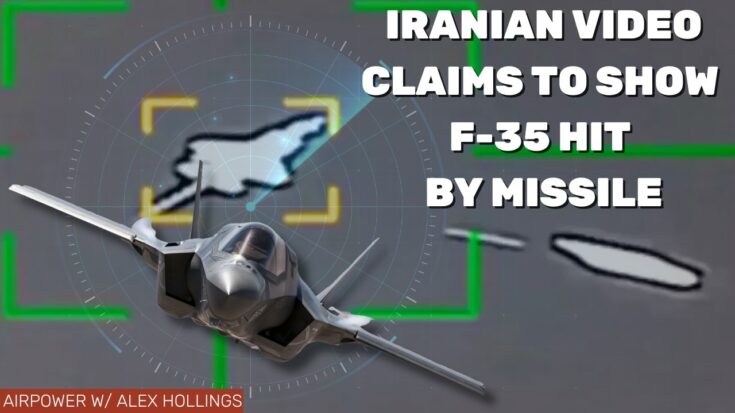
Footage released online, allegedly by Iran’s Islamic Revolutionary Guard Corps, purports to show an F-35 being struck by a surface-to-air missile. The footage has not been independently verified. Taken together, the confirmed emergency landing and the unverified footage suggest an F-35 may have taken a direct hit and returned to base anyway.

What the Footage Suggests
If the footage is genuine it raises immediate questions about what weapon hit the aircraft. The F-35 in the video takes no evasive action and deploys no countermeasures, which points away from a radar-guided system toward an infrared or electro-optically guided weapon. Iran operates the Majid short-range air defense system, a truck-mounted platform using electro-optical sensors rather than radar. It carries AD-08 interceptors with roughly 30-pound blast fragmentation warheads capable of reaching targets at approximately 8 kilometers and up to 20,000 feet. A man-portable system like Iran’s MISAGH-3 is also possible, carrying a smaller 3.3-pound warhead, which could explain the aircraft’s survival.

Both weapon types use passive sensors rather than radar emissions, meaning the pilot would receive no warning until the fighter’s distributed aperture system detected a launch infrared signature, potentially less than a second before impact.
What This Doesn’t Mean About Stealth
An F-35 being hit by Iranian fire does not indicate stealth failure. Stealth aircraft are not invisible to radar. They reduce their detectable radar cross-section to make detection and targeting significantly more difficult at range. A useful comparison is a standard dartboard versus one roughly an inch across placed on the opposite wall. The smaller target is harder to spot and harder to hit, but bring it close enough to the thrower and the difficulty decreases substantially. The F-35 operates the same way. Close enough to a targeting array under the right conditions, it can be engaged.

Iran’s longer-range systems, including Russian-sourced S-300s and domestically produced Bavar-373s, carry blast fragmentation warheads between 330 and 440 pounds. A proximity hit from either of those at full effect would not produce an aircraft that continued flying. The fact that the F-35 apparently returned to base suggests a smaller warhead, consistent with the short-range systems described above.
The Broader Picture
F-35s are assigned the highest-risk mission sets specifically because of their stealth and survivability. Thousands of sorties have been flown into Iran over the past several weeks. Iranian air defenses have downed at least 10 and possibly 11 MQ-9 Reaper drones to date. As operations extend deeper into uncontrolled airspace to hunt remaining air defense assets and ballistic missile launchers, the risk to manned aircraft increases regardless of platform.

If the footage is authentic this would be the first confirmed combat hit on an F-35 in its operational history. It would also be the first confirmed instance of an F-35 absorbing a direct hit and returning to base. Both facts matter equally.






