U.S. Reportedly Targets Iranian Anti-Ship Missile Sites With Newly Introduced 5,000-Pound Bunker Busters
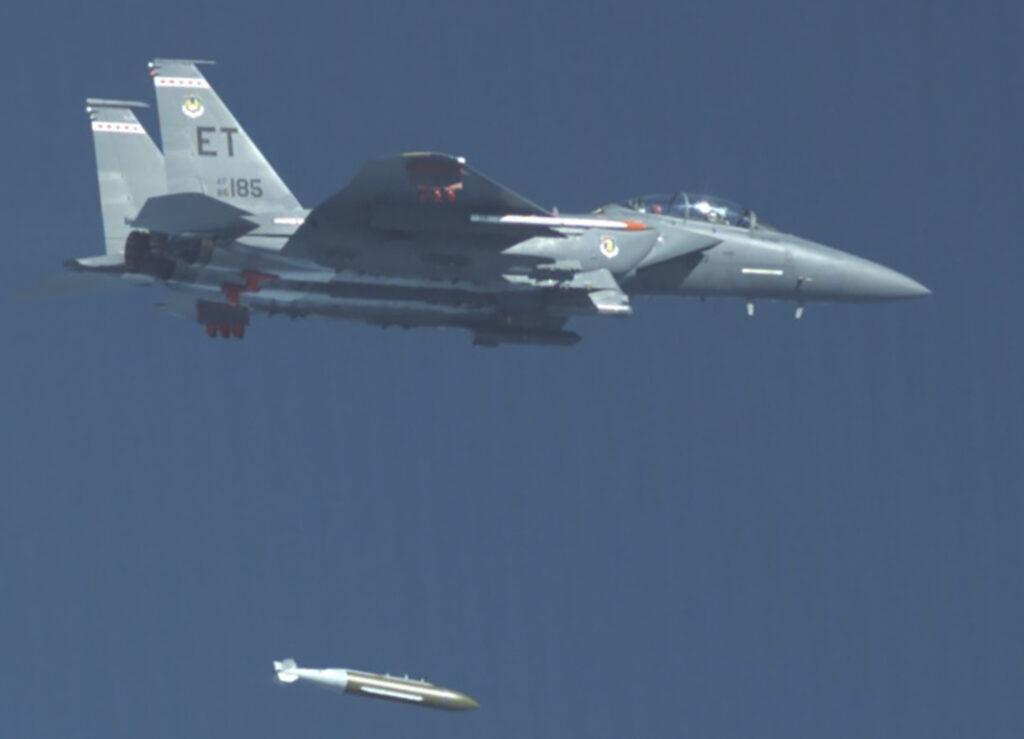
Samuel King Jr., Public domain, via Wikimedia Commons
Military activity around the Strait of Hormuz has entered a new phase following reports that the United States used a recently introduced bunker-buster bomb against Iranian missile facilities. According to statements released by U.S. Central Command and multiple media outlets, strikes carried out overnight targeted hardened anti-ship cruise missile sites positioned along Iran’s coastline. These installations were viewed as a direct threat to commercial vessels and naval forces operating in one of the world’s most important shipping routes.
The weapon believed to have been used is the GBU-72/B Advanced 5,000-pound Penetrator, sometimes called the A5K. This bomb fills a gap between widely used 2,000-pound bunker-buster weapons and the much larger 30,000-pound Massive Ordnance Penetrator. While officials have not publicly confirmed the exact munition, several U.S. defense sources indicated that deep penetrator bombs were employed to reach targets protected by reinforced structures or buried underground.
Reports of Combat Use and Official Statements
U.S. Central Command announced the operation through a public message stating, “Hours ago, U.S. forces successfully employed multiple 5,000-pound deep penetrator munitions on hardened Iranian missile sites along Iran’s coastline near the Strait of Hormuz.” The statement added that the targeted missiles posed risks to international shipping passing through the narrow waterway. Although the announcement did not name the weapon directly, defense reporters later cited officials confirming the use of the GBU-72/B.
Questions remain about whether this marks the first combat use of the bomb. Earlier reports in 2024 suggested that similar weapons may have been used during strikes on underground facilities linked to Iranian-backed Houthi forces in Yemen. Those claims were never officially confirmed, leaving uncertainty about the weapon’s operational history. U.S. officials declined to provide additional details when asked about the latest strikes, maintaining standard practice regarding sensitive weapons systems.
Development of a New Penetrator Weapon
The GBU-72/B was designed to replace the older GBU-28/B bunker-buster, which entered service during the early 1990s. Military planners sought a weapon capable of defeating deeper and more complex underground targets while using modern guidance technology already proven in other precision bombs. The newer design combines a heavy penetrating warhead with updated navigation systems, improving accuracy while reducing the number of weapons needed to destroy fortified sites.
At the center of the bomb is the BLU-138/B warhead, weighing more than four thousand pounds. Roughly one quarter of that weight consists of high explosives similar to those used in larger deep-penetration weapons. Attached to the rear is a guidance kit based on the Joint Direct Attack Munition system, which uses GPS and inertial navigation to guide the bomb toward fixed coordinates even in poor weather or limited visibility conditions.
Aircraft and Delivery Capabilities
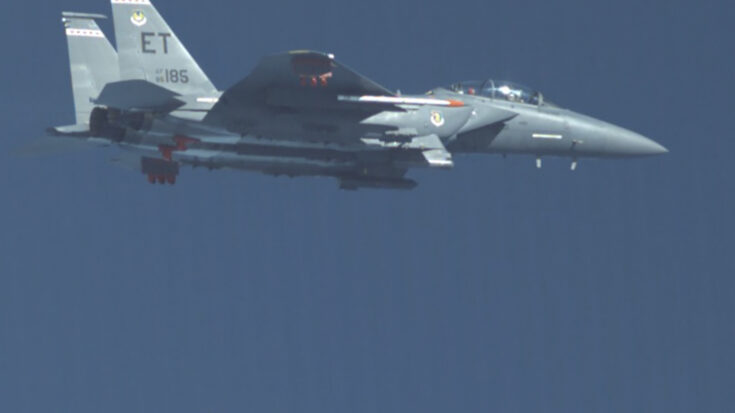
The U.S. Air Force has not publicly listed all aircraft cleared to carry the GBU-72/B in combat, but testing has provided clues. In 2021, an F-15E Strike Eagle successfully released the weapon during evaluation flights. Later images showed a B-1 bomber carrying the bomb externally, suggesting additional integration work. Defense planners have also discussed possible compatibility with the B-2 stealth bomber, which is frequently used against heavily defended targets.
These aircraft types have all participated in recent operations connected to Iranian targets, making them likely delivery platforms. Each offers different advantages. The F-15E can respond quickly from regional bases, the B-1 provides large payload capacity, and the B-2 allows penetration into defended airspace with reduced detection risk. Using multiple aircraft types increases flexibility depending on mission requirements and threat conditions.
Penetration Power and Operational Purpose
Precise performance figures remain classified, but earlier bunker-buster models provide a useful comparison. The older GBU-28 reportedly penetrated more than 150 feet of earth or at least 15 feet of reinforced concrete before detonating. Modern penetrators often use sequential strikes, where several bombs hit the same point to dig progressively deeper until reaching buried facilities.
The GBU-72/B offers a middle option between smaller penetrators and the limited inventory of Massive Ordnance Penetrators. The larger weapon is reserved for extremely hardened or strategically important sites. By contrast, the A5K allows planners to strike deeply buried targets without using the largest bombs available, conserving specialized munitions while maintaining effectiveness.
Strategic Context in the Strait of Hormuz
The attacks occurred amid rising tension surrounding the Strait of Hormuz, a narrow passage connecting the Persian Gulf to global shipping lanes. A significant share of the world’s oil exports moves through this corridor each day, making any disruption immediately felt in energy markets. Iranian anti-ship missile systems positioned along coastal areas are capable of threatening both military vessels and commercial tankers.
Although Iran possesses a large inventory of anti-ship cruise missiles, analysts note that many can be launched from mobile truck platforms designed to resemble civilian vehicles. This mobility makes detection difficult and increases uncertainty for ships operating nearby. Even without widespread missile launches, the threat alone has slowed maritime traffic and raised insurance costs for commercial operators.
Regional Impact and Security Measures
Drone attacks, missile threats, and concerns over naval mines have already reduced shipping activity in the region. Only a limited number of vessels have continued transiting the Strait, often under strict coordination. The slowdown has affected global energy prices and placed economic pressure on Gulf states that rely heavily on uninterrupted exports.
U.S. military planners have explored escorting merchant convoys through the waterway, though such operations carry risks due to the confined geography and potential for sudden attacks. Political debate has also shaped responses. President Donald Trump commented publicly on allied participation, writing, “I wonder what would happen if we ‘finished off’ what’s left of the Iranian Terror State, and let the Countries that use it, we don’t, be responsible for the so called ‘Straight?’ [sic].”
Future Operations and Military Outlook
Defense analysts believe additional strikes against hardened missile infrastructure may follow if threats to shipping persist. Facilities built into mountainsides or reinforced bunkers require specialized weapons capable of penetrating protective layers before detonation. The introduction of the GBU-72/B provides commanders with a new option suited to these missions while avoiding reliance on the largest available bombs.
The evolving situation reflects a broader shift in modern warfare, where underground facilities and mobile launch systems play larger roles in regional conflicts. As tensions continue, attention remains focused on how advanced precision weapons and strategic airpower shape operations around the Strait of Hormuz and influence stability across global trade routes.