

Why Britain Rejected a Faster Hurricane
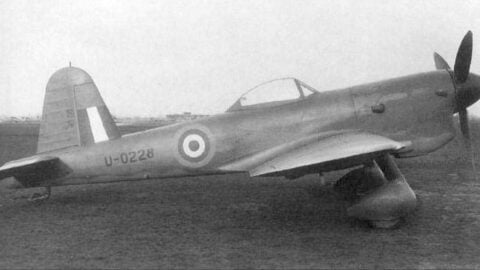
YouTube / Airvex-f3d
By December 1940, Britain faced sustained bombing while struggling to replace combat losses. To prepare for a potential disruption in Hurricane or Spitfire output, the Air Ministry authorized several emergency fighter concepts. One of the most unexpected was the Miles M.20.
Designed for rapid production, the M.20 used simplified construction methods and fixed landing gear to reduce manufacturing complexity. It relied on materials that would not compete directly with existing fighter programs. The goal was not to replace frontline aircraft under normal conditions, but to provide a fast interceptor that could be built quickly if standard production lines failed.
Speed That Challenged Assumptions
Flight testing produced results that surprised both engineers and officials. The M.20 reached approximately 333 mph, around 30 mph faster than the Hurricane Mk I. This performance contradicted conventional aerodynamic thinking. Fixed landing gear was expected to impose heavy drag penalties, yet the aircraft still achieved higher top speed.

Test pilots reported stable handling and predictable control response. The aircraft demonstrated acceptable climb performance and solid gunnery stability for interception work. Production studies also showed major advantages. The M.20 required roughly 60 percent fewer man-hours to build than a Hurricane, reducing strain on skilled labor and factory capacity.
Suitable for Day Interception
Evaluation trials indicated the aircraft met many requirements for daylight fighter operations. It could intercept bombers effectively, deliver competitive speed, and operate within established RAF tactics. Its rugged airframe and simplified systems also promised easier maintenance and faster turnaround times.
On technical and production grounds, the M.20 appeared to offer a practical solution to Britain’s aircraft shortage. The data supported its use as a stopgap interceptor that could supplement existing fighter forces if needed.
Rejected for Strategic Reasons
The aircraft’s fate was sealed by a shift in operational priorities. By late 1940, German bombing increasingly took place at night. Britain’s air defense effort focused on developing night fighters equipped with radar and specialized interception systems.

In a December 30 letter, Air Secretary Archibald Sinclair judged the M.20 unsuitable within this evolving strategy. The aircraft lacked the equipment and design features required for effective night fighting. As a result, resources were directed toward platforms better suited for nocturnal interception.
A Fighter Built for the Wrong Phase
The Miles M.20 was not rejected because it failed to perform. It delivered speed, simplified production, and solid flight characteristics. Its rejection reflected a change in how Britain needed to fight the air war. The aircraft arrived at a moment when night defense, not daytime interception, had become the priority, leaving a faster Hurricane alternative confined to history.







