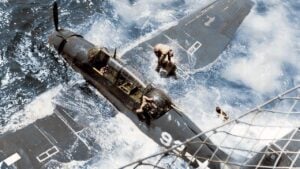
The Misunderstood Saga of the P-38 Lightning
YouTube / TJ3 History
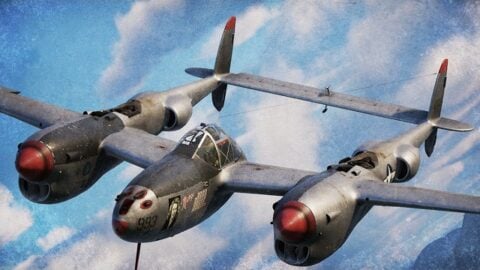
When the Lockheed P-38 Lightning first showed up in the late 1930s, the world had never seen a fighter like it before. Its twin-boom design, central cockpit, and twin engines gave it a futuristic profile that set it apart from single-engine rivals.
Designed to meet the demanding requirements of the U.S. Army Air Corps for speed, altitude, and range, the P-38 was an ambitious aircraft built around cutting-edge technology. From the outset, it promised performance well beyond that of existing fighters, but that promise came with complications.
Innovative Design, Complex Reality
The P-38 incorporated advanced features, including turbo-supercharged engines, tricycle landing gear, and heavy nose-mounted armament. These innovations allowed it to excel at high altitudes and long-range missions. However, the same complexity that made the Lightning exceptional also made it difficult to maintain and fly. Early models suffered from issues such as compressibility in high-speed dives, engine management challenges, and cockpit heating problems, particularly in cold European climates. These early shortcomings contributed to its mixed reputation.
A Tale of Two Theaters
Nowhere was the P-38’s story more divided than in its combat performance across different theaters of war. In the European Theater, the Lightning faced stiff competition from agile German fighters and struggled with reliability in harsh conditions. In contrast, the Pacific Theater revealed the aircraft’s true strengths. Its long range, heavy firepower, and twin-engine reliability made it ideal for vast ocean distances and escort missions. It was here that the P-38 truly earned its stripes.
Ace Maker of the Pacific
The Lightning became synonymous with air superiority in the Pacific. America’s top two aces of World War II, Richard “Dick” Bong and Thomas McGuire, both flew the P-38, amassing the majority of their victories in the aircraft. Its concentrated nose-mounted guns allowed for devastating accuracy, while its twin engines offered reassurance over long, unforgiving stretches of water. These advantages helped the P-38 dominate Japanese aircraft and secure its place in aviation history.
More Than a Fighter
Beyond air-to-air combat, the P-38 proved remarkably versatile. It served as a fighter-bomber, photo-reconnaissance platform, and long-range interceptor. One of its most famous missions was Operation Vengeance in 1943, when P-38s carried out the long-range interception that led to the death of Japanese Admiral Isoroku Yamamoto. Few fighters of the era could have executed such a mission.
The P-38’s reputation suffered largely because it was judged by the standards of simpler fighters. Pilots unfamiliar with its unique handling characteristics often struggled during training, and early technical problems overshadowed its later refinements. As newer fighters like the P-51 Mustang entered service, the Lightning was gradually eclipsed in popular memory, despite its continued effectiveness.
A Legacy Reconsidered
Today, historians increasingly recognize the P-38 Lightning as one of the most important and capable fighters of World War II. It was not a flawed aircraft, but a sophisticated one that demanded an equally sophisticated understanding. The misunderstood saga of the P-38 is ultimately a story of innovation, adaptation, and quiet excellence, proof that being ahead of its time often comes at a cost.