Fiat G.55 – Italy’s Centaur of WW2
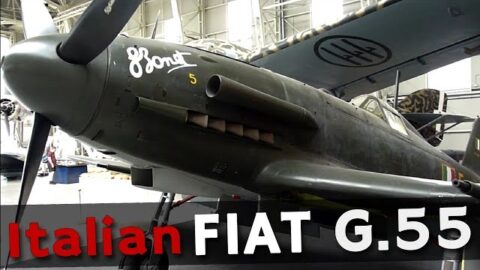
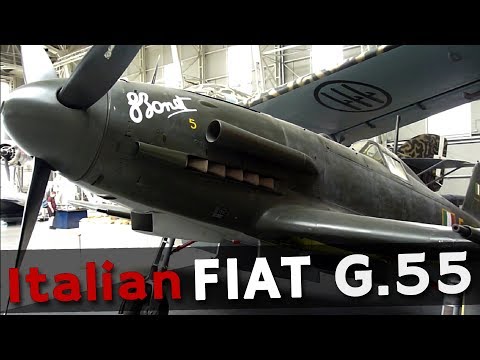
YouTube / Military Aviation History
In 1943, Italy found itself fighting to remain relevant in an air war that was rapidly leaving its earlier fighters behind. The Regia Aeronautica urgently needed a new generation interceptor capable of meeting Allied aircraft on equal terms.
Three contenders emerged to answer that call: Fiat’s G.55 Centauro, Macchi’s M.C.205 Veltro, and Reggiane’s Re.2005 Sagittario. True to form, Italian industry chose not to pick a single winner—production was ordered for all three. Among this trio, the Fiat G.55 would earn a reputation as perhaps the finest Italian fighter of the war.
Design and Development
The Fiat G.55 was designed by Giuseppe Gabrielli, whose philosophy emphasized structural strength, good handling, and growth potential. First flying in April 1942, the Centauro featured an all-metal airframe, broad wings for stability, and excellent high-altitude performance. Its DB 605 engine, license-built in Italy, gave the aircraft both power and reliability- critical qualities in the increasingly demanding air war.
One of the G.55’s greatest strengths was its armament. Early versions carried three 20 mm cannons and two 12.7 mm machine guns, delivering a heavy punch compared to most contemporary fighters. With a top speed of around 620 km/h (385 mph) and solid climb performance, the G.55 could effectively engage bombers and fighters alike, particularly at higher altitudes where Allied formations often operated.
Combat Service
The G.55 entered service in 1943 and saw combat during the defense of Italy against Allied bombing raids. After Italy’s armistice, the aircraft served on both sides of the conflict- some flown by the Italian Co-Belligerent Air Force, others by the Aeronautica Nazionale Repubblicana under German supervision. Luftwaffe evaluations were highly positive, with German pilots praising the Centauro’s handling and combat effectiveness.
Despite its excellence, the G.55 arrived too late and in too few numbers to alter Italy’s fortunes. Industrial disruption, material shortages, and Allied bombing severely limited production. Fewer than 300 examples were completed, a fraction of what was needed to make a strategic impact.
Legacy of the Centaur
The Fiat G.55 remains one of the great “what-if” fighters of World War II. Technically superb and well-balanced, it demonstrated that Italian designers could match the best aircraft of the era. Though overshadowed by more numerous Allied and German fighters, the Centauro stands today as the pinnacle of Italian piston-engine fighter design- a worthy symbol of Italy’s last, valiant effort in the skies of World War II.