When the Sabre Met the MiG: The Jet Dogfights That Changed Air Combat Forever
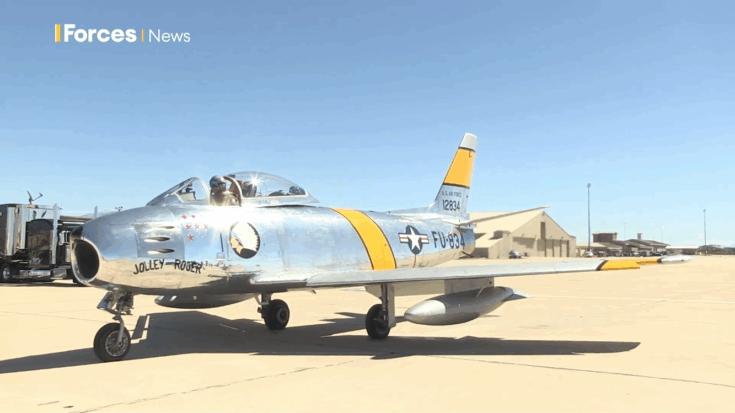
YouTube / BFBS Forces News
The First True Jet War
Seventy years ago, the skies over Korea became the setting for aviation history’s first sustained jet versus jet conflict. What is often reenacted today as an air show display was once a deadly contest between two rival designs, the American F-86 Sabre and the Soviet MiG-15. Their encounters marked a turning point in how air wars would be fought from that point forward.

When United Nations forces entered the Korean War in 1950, air superiority initially came quickly. American B-29 bombers struck targets across North Korea, supported by P-51 Mustangs and early jet fighters such as the F-80 Shooting Star. That advantage vanished almost overnight.
The Arrival of the MiG-15
The sudden appearance of the MiG-15 shocked Allied aircrews. With swept wings, high speed, and heavy armament, the Soviet designed fighter outperformed every UN aircraft then operating over Korea. Losses among B-29 formations climbed rapidly, forcing the bombers to shift to night missions to survive.

The MiG-15 had been built as a bomber interceptor, and its weapons reflected that mission. A single 37 millimeter cannon and two 23 millimeter cannons delivered devastating firepower. Against slower bombers, a short burst could be enough. Against fast moving fighters, however, those guns proved harder to aim with precision.
The F-86 Sabre Enters the Fight
To counter the MiG threat, the United States rushed its most advanced fighter to the theater. The North American F-86 Sabre was not superior on paper. The MiG could climb faster, reach higher altitudes, and out turn it at certain speeds. The Sabre’s advantage came from stability, control at high speed, and a radar assisted gun sight that proved critical during jet combat.

Armed with six .50 caliber machine guns, the F-86 relied on accuracy rather than raw hitting power. MiGs often returned home riddled with bullets, yet still flying. Victory frequently depended on pilot skill rather than technical specifications.
MiG Alley and the Human Factor
Most engagements took place in a narrow stretch of airspace near the Yalu River known as MiG Alley. MiGs often launched from bases in Communist China, flown not only by North Korean and Chinese pilots, but also by experienced Soviet veterans. Many Sabre pilots only later learned who they were truly fighting.

American pilots repeatedly described the shock of facing an enemy intent on killing them in close range combat. Survival often came down to teamwork, with wingmen saving each other in seconds that decided life or death.
Lessons That Shaped the Future
By war’s end, Sabre pilots claimed an eight to one kill ratio, though later analysis showed that experience and training played a major role in that outcome. Today, only a handful of airworthy examples remain, usually seen together in museums.

The real legacy of the F-86 and MiG-15 lies in what they taught. High speed maneuvering, pilot coordination, and systems integration became the foundation of modern air combat, lessons written in contrails over Korea.