





The German WWII Aircraft Designed to Rise Like a Helicopter and Race Like a Jet
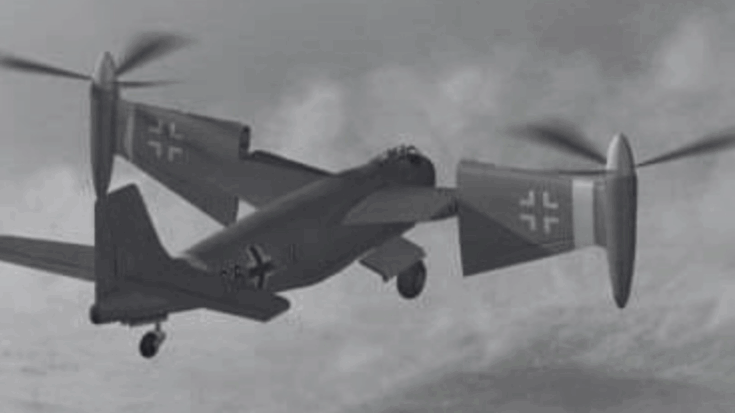
Tales of War - WWII Documentaries / YouTube
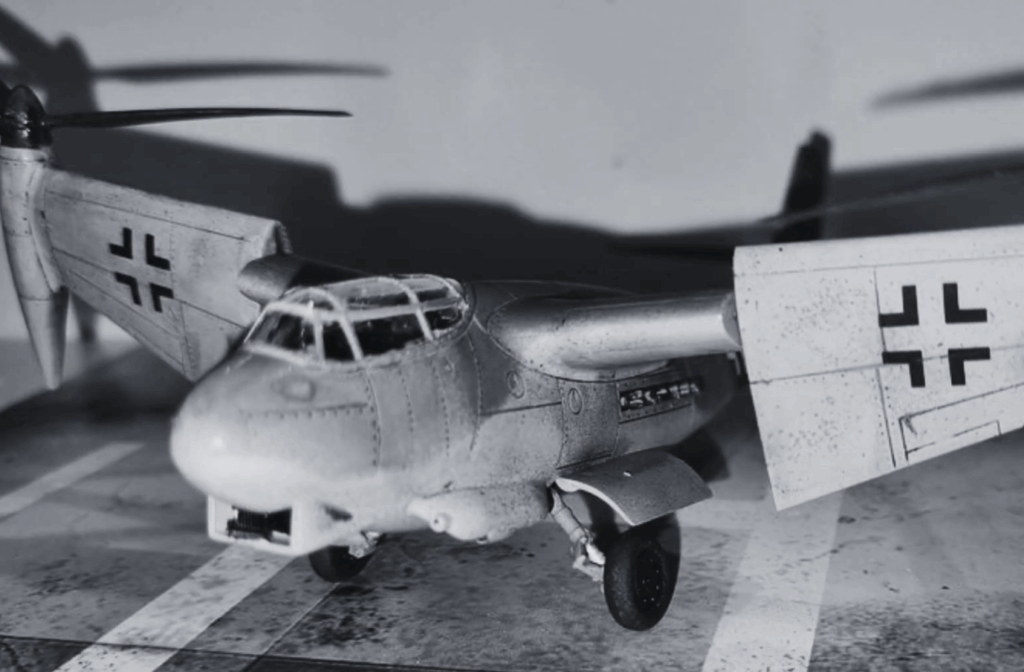
During the later years of World War II, German engineers explored unusual ideas as they searched for new ways to gain an advantage in the air. One of the boldest concepts was the Weserflug P.103, a hybrid aircraft designed to lift off like a helicopter and then accelerate with jet power. Although the aircraft never left the drawing stage, the surviving documents reveal how far designers hoped to push aviation technology during a difficult period.
A Concept Ahead of its Time
The early sketches showed a machine unlike anything built during the war. It featured large rotor arms for vertical lift, combined with jet boosters for high-speed forward flight. Engineers hoped to create an aircraft that could rise straight up from small clearings and then fly as fast as early jets once in the air. The idea attempted to bring together two different forms of flight that had never been combined successfully.
The project emerged when Germany needed an aircraft that could take off without a long runway. Many airfields were damaged or threatened, making vertical lift an appealing option. Traditional helicopters could not reach the needed speeds, and fixed-wing fighters required long landing strips. A tiltrotor aircraft seemed like a solution, but the technology was far from mature.

The Challenge of a Hybrid Machine
Weserflug engineers proposed a design with rotor arms that could tilt forward after takeoff. In helicopter mode, the rotors would lift the aircraft. Once airborne, the arms would rotate forward and the jet boosters would engage, turning the aircraft into a high-speed machine. No aircraft in the world at the time attempted such a transition, and the design pushed far beyond what wartime industry could support.
The plan required difficult calculations for aerodynamic forces and mechanical stress. Engineers had to consider how the tilting arms would behave at speed, how the frame would support both lift and jet thrust, and how pilots could control the aircraft during transition. Every part required a level of precision that was difficult to achieve with available materials.
Technical Problems
One major challenge was powering the rotors for vertical takeoff. The early design called for a central engine connected to both rotors through a shared gearbox. This gearbox would have been extremely large and under heavy strain. Even traditional helicopters suffered gearbox failures, so using one in a far heavier hybrid aircraft added serious risk.
Another issue came from the jet boosters. These engines had to ignite only after the rotor arms locked into place. If the jets fired too soon, the arms could break apart or the aircraft could lose control. The required timing depended on mechanical systems and pilot input, since advanced sensors did not exist. This made the design dangerous even on paper.
Aerodynamic Difficulties
Engineers also debated what should happen to the rotors during jet flight. Leaving them extended increased drag and vibration. Folding them required complex mechanisms. Removing them entirely was impossible since they were needed for takeoff. These problems added new layers of difficulty, and each proposed answer created another engineering issue.
Weight balance was another concern. The heavy jet boosters shifted the center of gravity, making stability uncertain during both vertical lift and forward flight. Even a small error in weight distribution could cause the aircraft to pitch or roll uncontrollably.
A Design Limited by its Era
Despite these challenges, engineers continued refining the concept on paper. They experimented with different rotor shapes, jet placements, and fuselage structures. Some believed that with enough time the design might work, but many agreed it would require years of research and new technology.
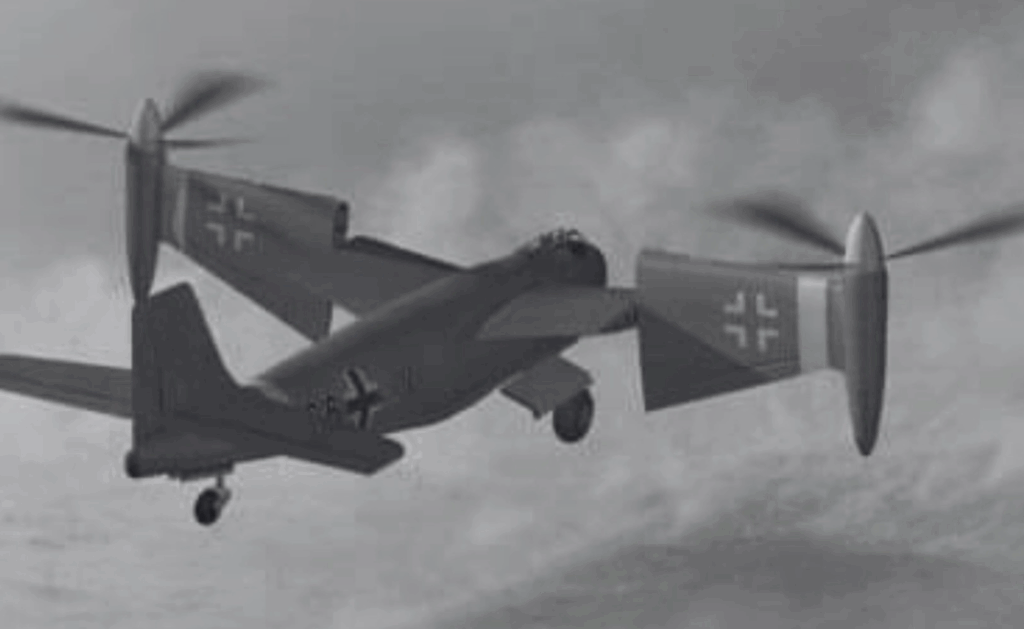
When compared with later tiltrotor aircraft like the V-22 Osprey, the limits of the wartime design become clear. Modern tiltrotors rely on advanced computers to stabilize the aircraft during transition, while the P.103 depended entirely on mechanical systems and pilot skill. It was an idea far ahead of the materials and tools available.
Legacy of an Unrealized Aircraft
The P.103 never reached the prototype stage because Germany no longer had the resources to build such a complex machine. After the war, Allied engineers studied the surviving documents and noted how early the tiltrotor idea had appeared. Although the aircraft was impractical for its era, the design reflected an interest in mixing vertical lift with high-speed flight long before those ideas became workable.
The P.103 remains one of the most unusual aircraft concepts proposed during the war. It shows how innovation continued even when circumstances made development nearly impossible, leaving behind an idea that later generations of engineers would revisit in more advanced forms.