

Germany’s Obsession With Heavy Fighters: Messerschmitt Me 410 Hornet
YouTube / IHYLS
In the years leading up to World War II, air forces around the world became fascinated with the idea of the heavy fighter. The concept promised everything military planners wanted: long range, heavy firepower, room for radios and navigators, and the ability to escort bombers deep into enemy territory. Germany was one of the strongest proponents of this doctrine, viewing heavy fighters as multi-role aircraft that could replace several specialized designs.
Germany’s first serious attempt was the Messerschmitt Bf 110. On paper, it looked formidable- twin engines, multiple crew members, and heavy armament. In the early campaigns over Poland and France, it seemed successful. But during the Battle of Britain, the illusion collapsed. The Bf 110 proved too slow and too unmaneuverable against single-engine fighters like the Spitfire and Hurricane. What was meant to be a bomber destroyer often became an easy target.
Trying to Fix a Broken Concept: Me 210 and Me 310
Rather than abandoning the heavy fighter idea, German designers tried to fix it. The Me 210 was meant to be a sleek, improved replacement for the Bf 110. Instead, it became one of Germany’s most notorious aviation failures. Plagued by severe handling problems and instability, the aircraft was dangerous to fly and impossible to fix quickly. The proposed Me 310 existed mostly as a paper project, an attempt to salvage the design without fully confronting the deeper problem.
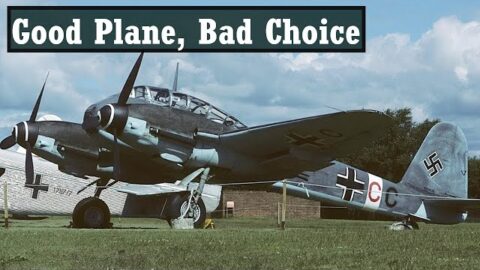
The Messerschmitt Me 410 Hornisse was the final and most refined evolution of this troubled lineage. With more powerful engines, a lengthened fuselage, and improved aerodynamics, it finally delivered acceptable performance. In some roles, the Me 410 was genuinely effective, especially as a bomber destroyer armed with heavy cannons. Yet even at its best, it was still fighting a war that had moved on.
Lessons Learned Too Late
Like many heavy fighters, the Me 410 found its true value outside of traditional air-to-air combat. It performed better as a night fighter, reconnaissance aircraft, fast bomber, and ground-attack platform. In these roles, its range, payload, and crew coordination made sense. But this was an admission that the original heavy fighter dream had failed.
By the time the Me 410 entered service, the limitations of the heavy fighter concept were undeniable. Other nations adapted by building aircraft like the American P-38 Lightning, which combined twin engines with excellent performance, or by shifting resources toward agile single-engine fighters. Germany, however, continued pouring time and materials into an idea that no longer matched the realities of air combat.
What Germany Should Have Built Instead
In hindsight, Germany’s resources may have been better spent on aircraft that embraced speed, climb, and maneuverability or on advanced designs like the Dornier Do 335, which addressed many of the heavy fighter’s flaws with a radically different layout. The Me 410 was not a bad aircraft, but it was the product of an outdated obsession.
The story of the Messerschmitt Me 410 Hornisse is not just about one aircraft- it is about a doctrine that refused to die. Germany’s fixation on heavy fighters delayed more effective solutions and consumed valuable resources. The Me 410 stands as a reminder that in war, clinging to elegant theories can be just as dangerous as the enemy itself.







