Germany’s Stratospheric Interceptor
YouTube / AllthingsWW2
By the final, desperate years of WWII, the battle for air superiority was no longer being fought only over the front lines. It was far above them. In the thin air at the edge of the atmosphere, Germany sought an answer to high-flying Allied bombers. The result was the Blohm & Voss BV 155.
Flying for the first time just as the war was slipping away, this extraordinary interceptor was designed to climb to extreme altitudes where few aircraft could follow. With its long wings, powerful engine, and cutting-edge engineering, the BV 155 represented one of the absolute high points of propeller-driven military aviation. It was a glimpse of what might have been, had it arrived sooner.
Fighting a War Above the Battlefield
By 1943–1944, the air war over Europe had entered a new phase. Allied bombers were operating at ever-higher altitudes. Thus, exploiting the limits of German fighter performance to reduce losses. Traditional interceptors struggled in the thin air, where engines lost power and wings lost lift. In response, Germany began pursuing specialized aircraft designed not for dogfighting, but for one purpose only. That is to reach the stratosphere and hunt high-flying bombers.
The aircraft that would become the BV 155 began as a Messerschmitt design, originally tied to the Bf 109 lineage. But as Messerschmitt’s priorities shifted, the project was handed over to Blohm & Voss. It was an unconventional choice, given the company’s stronger reputation in shipbuilding than fighter design. However, this transfer proved decisive. Blohm & Voss embraced radical solutions and reshaped the aircraft into an extreme high-altitude specialist, unconstrained by the need for versatility or mass production.
Built for the Thin Air
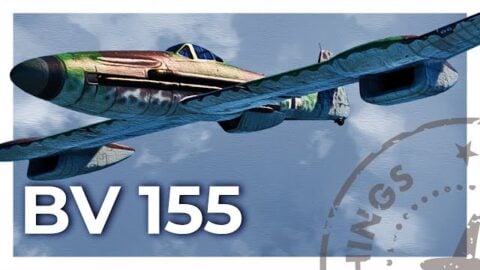
The BV 155’s enormous, high-aspect-ratio wings were optimized to generate lift at altitudes. This wing design gave the aircraft a glider-like silhouette. Powered by the Daimler-Benz DB 603, it retained strong performance at extreme altitudes.
However, cooling the engine proved difficult- forcing unconventional radiator layouts and repeated redesigns to balance airflow, drag, and temperature.
Life at the Edge of the Atmosphere
Operating at extreme altitude was as much a human challenge as a mechanical one. Pilots faced freezing temperatures, low oxygen levels, and long climbs that could take them far above the relative safety of lower altitudes. The BV 155 was intended to operate with pressurization and oxygen systems suitable for prolonged high-altitude flight. Thus, reflecting its role as a stratospheric interceptor rather than a conventional fighter.
In combat, it would not have relied on agility. Instead, the BV 155 was designed to climb above bomber formations. It would position itself for an interception, striking from a position of altitude advantage.
Too Late, Too Few
Despite its promise, the BV 155 was doomed by timing. Development dragged on amid worsening shortages, Allied bombing, and constant design changes. As a result, only a small number of prototypes were completed. The aircraft flew for the first time near the very end of the war. By then, Germany’s industrial base was collapsing, fuel was scarce, and jet fighters were already pointing toward the future of air combat.
The BV 155 represents one of the most extreme attempts to push piston-engine technology to its absolute limits. Its projected service ceiling placed it among the highest-flying propeller-driven military aircraft ever designed. In that sense, it was not merely another late-war prototype. It was a technological endpoint- the culmination of decades of incremental improvement in propeller-driven flight.