

How Effective Were P-47s Against German Trains?
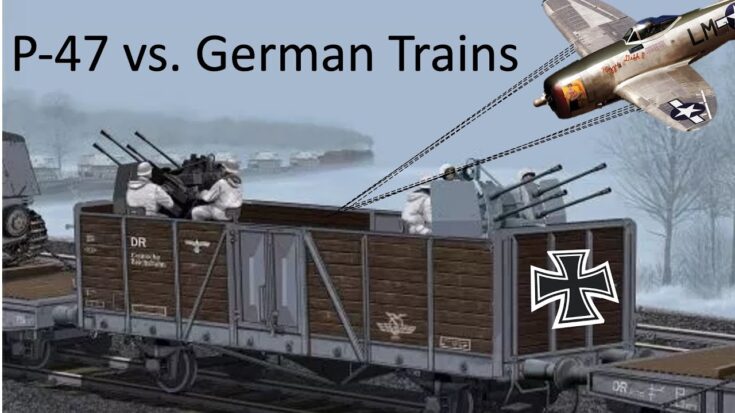
YouTube / WWII US Bombers
Why Trains Became a Target
By 1944, Allied planners understood that Germany’s war effort depended on rail transport. Locomotives moved troops, fuel, ammunition, and industrial goods across occupied Europe. Once bomber escorts completed their primary missions, US fighters began attacking trains on the return flight. This shift turned fighter aircraft into mobile interdiction weapons aimed at choking German logistics.

Eighth Air Force documents ranked rail targets second only to the destruction of the Luftwaffe itself. By the end of the war, US fighters claimed more than 4,600 locomotives destroyed, along with thousands of wagons and rail cars.
Why the P-47 Was Suited for the Job
The P-47 Thunderbolt emerged as the most effective American train strafing aircraft. It carried six or eight .50 caliber Browning M2 machine guns, each with deep ammunition reserves and a combined rate of fire capable of saturating a target in seconds. Its air-cooled radial engine tolerated damage better than the liquid-cooled engines of the P-51 or P-38, an important advantage when facing concentrated ground fire.

In early 1944, the Eighth Air Force operated far more P-47s than any other fighter type, making it the aircraft most frequently available for ground attack missions.
Tactics and Lessons Learned
Pilots quickly learned that train strafing required discipline and precision. Attacks were most effective when flown perpendicular to the train’s direction of travel. This approach reduced anti-aircraft gun accuracy and allowed for a faster escape. A dive angle of roughly 15 degrees balanced visibility, accuracy, and recovery margins.

Engines and locomotives were the primary targets. A boiler breach could disable a train immediately and was often visible through a plume of steam. Coal cars proved ineffective targets, while ammunition cars were extremely dangerous due to secondary explosions. Stationary trains were treated with caution, as some were decoys protected by concealed flak guns.
Losses and Results
Train strafing was hazardous but not disproportionately costly. Records from the 65th Fighter Wing show that only 14 aircraft were lost during train attacks, compared to far higher losses during airfield strafing. The threat from rail-mounted anti-aircraft guns was real, but manageable with proper tactics.

The strategic effect was measurable. In France, fighter attacks reduced weekly rail traffic by more than two thirds between February 1944 and D-Day. Fear of daylight movement forced trains to operate at night or halt altogether, compounding logistical delays.
Overall Impact
P-47 attacks on German trains combined physical destruction with psychological pressure. Locomotives were destroyed, rail lines disrupted, and crews intimidated into slowing or abandoning operations. The Thunderbolt did not win the war alone, but its role in paralyzing German rail transport directly supported Allied ground advances and the success of the Normandy invasion







