

The Corsair’s Hidden Edge
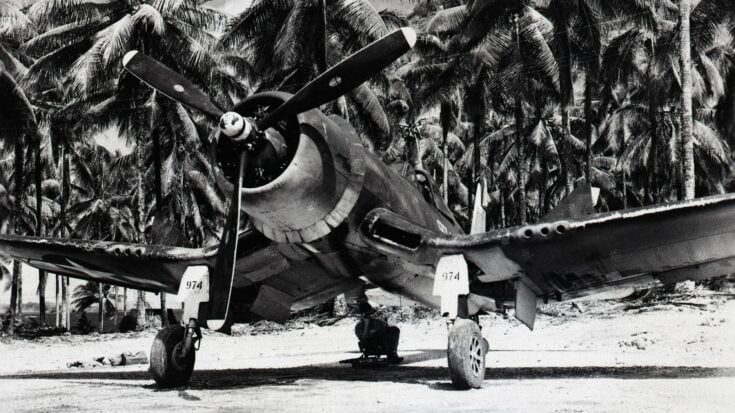
YouTube / Greg's Airplanes and Automobiles
By the final year of the war, the Vought F4U-4 Corsair had developed a reputation for speed and power. Yet one of its most useful combat features appeared only when the fight slowed down: its maneuvering flaps.
Flaps and Turn Performance
Data from National Advisory Committee for Aeronautics showed that flaps improve turning performance only once an aircraft approaches its stall-limited speed. At higher speeds, where structural G limits dominate, flaps offer little advantage. As speed drops and the wing nears stall, additional lift from properly designed flaps can reduce stall speed and tighten the turn.

Not all flaps performed equally. Split flaps, used on aircraft such as the Supermarine Spitfire, generated significant drag with limited lift. Fowler flaps, found on the Lockheed P-38 Lightning, increased wing area and provided substantial lift. The Corsair employed slotted flaps, which balanced lift and drag effectively at moderate deflections.
The 20-Degree Combat Setting
The F4U-4 featured a dedicated 20-degree maneuvering setting, usable at or below 200 knots indicated airspeed. In a descending speed spiral, this setting reduced stall speed significantly. That allowed the pilot to increase bank angle briefly while the opposing aircraft remained above its own flap extension limit.

In a close engagement against aircraft such as the Nakajima Ki-84, timing mattered. If the Corsair reached 200 knots first, its pilot could deploy maneuvering flaps and momentarily out-turn an opponent still restricted by speed. That window could last only seconds, but in a turning fight, seconds determined firing position.
Limits and Risks
The Corsair’s capability depended heavily on pilot skill. NACA evaluations criticized its stall warning characteristics, noting that precise control near the edge of stall was difficult. Accident statistics reflected the challenge: far more Corsairs were lost in operational mishaps than in air-to-air combat.

Flaps offered a tactical option, not a default solution. By 1943, American doctrine emphasized energy fighting over prolonged turning engagements. Still, under specific speed and load conditions, the Corsair’s maneuvering flaps provided a measurable advantage grounded in engineering data rather than legend.







