THE GERMAN GUN THAT DESTROYED ALLIED BOMBERS
YouTube / Military Aviation History
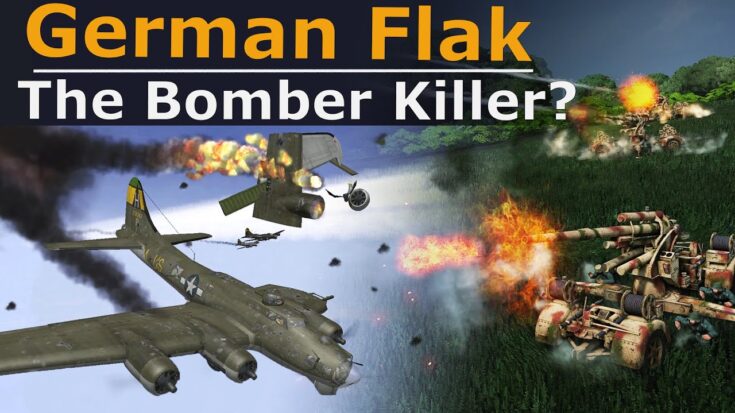
Every photograph of an Allied bomber stream over Europe shows the same thing alongside the aircraft: black puffs scattered across the sky. Each one was an 88mm shell detonating at altitude. The gun producing them, the Flak 18/36/37 series, was designed in the late 1920s by Krupp using a WWI-era designation as cover for a Treaty of Versailles violation.
How It Worked
The gun fired an 88mm shell at high muzzle velocity with a theoretical rate of 20 rounds per minute for a well-trained crew, though ammunition consumption often led operators to reduce that deliberately. The critical feature was the time-delay fuse. Shells did not detonate on contact with an aircraft. They were set to explode at a calculated altitude within the bomber stream, sending shrapnel outward from the casing in a concentrated pattern. Static testing showed roughly 70 percent of fragmentation concentrated within the main burst area, with 60 percent of all shrapnel remaining within three meters of the detonation point before dispersing. That three-meter radius was where the shell was most lethal.

This explains a consistent observation from surviving crews: if you could see a puff of smoke in the sky, you were probably safe. If you saw the actual explosion, you were likely already inside the lethal radius.

Batteries were organized into four-gun units commanded by a Kommandogerät, a fire direction device that tracked incoming bomber formations by heading, range, and altitude. Later versions fed that data directly to an automatic system that set each shell’s time fuse before firing. Individual gun crews did not need to visually track targets. They followed transmitted targeting instructions, maintaining fire on the lead formation element until it passed out of range, then shifting to the next.
What the Data Shows
A study of roughly 3,000 B-17s and 900 B-24s returning to UK bases in July 1944 broke down flak damage by aircraft surface per square foot per thousand aircraft. The data carried an acknowledged survivor bias since it only covered aircraft that returned. Among the crew casualty data from the 8th Air Force covering June through August 1944, 86 percent of all casualties across 944 damaged returning aircraft resulted from flak rather than fighter attack. That figure covered both wounded and killed personnel.

The casualty breakdown across crew positions showed waist gunners as a significant outlier, partly because heavy bombers typically carried two. Navigator and bombardier positions showed high casualty rates consistent with the unprotected nature of the bomber’s nose. Per 100 hits, B-17s produced 34 casualties against 19 for B-24s, though both aircraft had similar loss ratios overall, suggesting B-17s were more likely to return damaged while B-24s that took equivalent hits were less likely to make it back.
What Armor Changed
The flak vest, a protective garment worn by American bomber crews to absorb shrapnel, produced measurable results in the data. Observed chest hits ran 60 percent below the rate expected based on body surface area. Abdomen hits ran 80 percent below. Both figures reflected protection from the vest rather than a genuine reduction in shells reaching those areas.

A separate small study on helmet use showed head wounds were fatal in 77 percent of cases without a helmet and 58 percent with one, a reduction of nearly 20 percentage points, though the sample size was noted as insufficient for full statistical confidence.
The Final Count
Between August 1942 and May 1945, American heavy bomber losses over Europe totaled approximately 4,050 to fighter attack and 2,439 to anti-aircraft fire. Through most of the war fighters accounted for more losses. By 1945, as the Luftwaffe’s fighter force collapsed, flak became the dominant cause of bomber attrition. German flak defenses expended enormous quantities of ammunition to produce those numbers, but the organizational sophistication behind them, the centralized fire direction, the automatic fuse-setting systems, and the sheer density of batteries around defended targets, made them the most capable ground-based air defense system in the world by 1944.
The psychological impact of flying through a barrage while unable to maneuver or return fire is absent from casualty statistics. It was not absent from the experience of the crews who flew through it.