In Defense of the Worst Aircraft of World War 2
YouTube / Military Aviation History
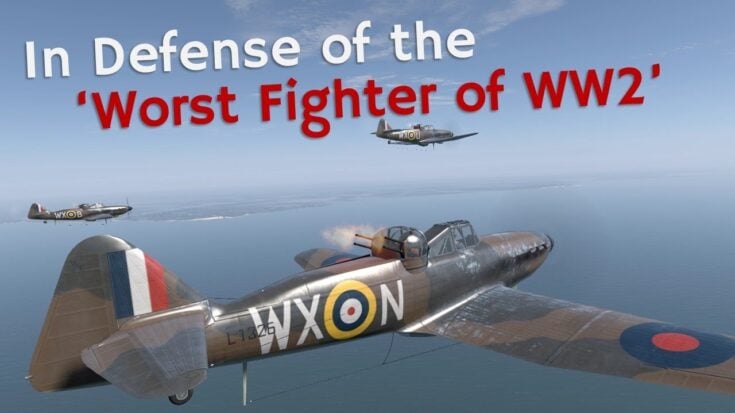
The Boulton Paul Defiant appears in at least one published book titled “The World’s Worst Aircraft.” That reputation rests almost entirely on a narrow slice of its service history while ignoring everything else. The fuller story is more complicated and considerably more interesting.

Why It Existed
The Defiant grew from a concept that traced back to WWI thinking about dedicated bomber destroyers. The RAF wanted a single-engine turreted fighter capable of intercepting enemy bombers, operating at night if necessary, with performance comparable to the Hurricane and Spitfire.

What they received had worse performance than both, which was predictable given the fundamental difference in design priorities. The Defiant carried a four-gun electro-hydraulic turret of French origin, licensed by Boulton Paul in 1934 and fitted with four .303 Browning machine guns at 600 rounds per gun. The pilot had no guns of his own. A modification allowing the turret to lock forward theoretically gave the pilot a firing option, but without synchronization gear it would have destroyed the propeller as readily as any enemy.
What Actually Happened at Dunkirk
Defiant crews claimed 65 German aircraft during the Dunkirk evacuation in May 1940. On May 29 alone they claimed 37. Records now show only 14 German aircraft were lost that entire day across all causes. Crews made those claims in good faith during chaotic multi-aircraft engagements where multiple gunners were targeting the same aircraft simultaneously. The Defiant certainly damaged German aircraft, forcing many to abort their missions, but few were actually destroyed.

The frequently repeated claim that Luftwaffe pilots initially mistook the Defiant for Hurricanes and paid heavily for the mistake is unsupported. German aeronautical magazines had published photographs and technical descriptions of the Defiant following its appearance at a Royal Aeronautical Society event in May 1939. When Bf 109s engaged Defiants on May 13 1940, they shot down five of six. The Luftwaffe knew exactly what they were facing.

During the Battle of Britain, four engagements produced claims of 19 German bombers against 11 Defiants lost. The RAF concluded the losses were unsustainable and the aircraft was out of its depth in daylight combat. Popular history stops here.
The Night Fighter Chapter
Rather than retire the type, the RAF transferred Defiant squadrons to night operations where the absence of forward armament mattered less and the turret’s wide field of fire became more useful. Early results were poor. Accidents were frequent and German night activity was initially limited. Crews developed a new tactic: spotting an enemy bomber from above, diving below it, positioning slightly behind, closing the distance, and firing upward into the wings and engines. The attack came from below the bomber’s defensive coverage with minimal warning.

Seven Defiant night fighter squadrons were operational as German bombing intensified. They achieved meaningful results during periods of high enemy activity before the Bristol Beaufighter arrived in sufficient numbers to replace them. By mid-1942 the last Defiant night fighter squadron had transitioned to the Beaufighter. Based on figures compiled by historian Alec Brew, Defiant squadrons claimed 152 aerial victories against 37 losses to enemy action across their entire operational career, though Brew himself cautioned those figures should be treated as a guide rather than a precise accounting.
What It Did After the Fighting
The Defiant’s operational story ended in 1942 but its service did not. The airframe was used to test new turret designs and early ejection seat concepts. It served as a target tug, a gunnery trainer, and an air-sea rescue aircraft. In 1942 and 1943 it contributed to early electronic warfare operations against German radar systems. These were practical contributions that rarely appear in assessments of the type.

The Defiant was built around a concept that the realities of WWII air combat invalidated quickly. That failure was real. What followed it was not failure at all.