How A Cargo Plane Won WWII
YouTube / Premier History
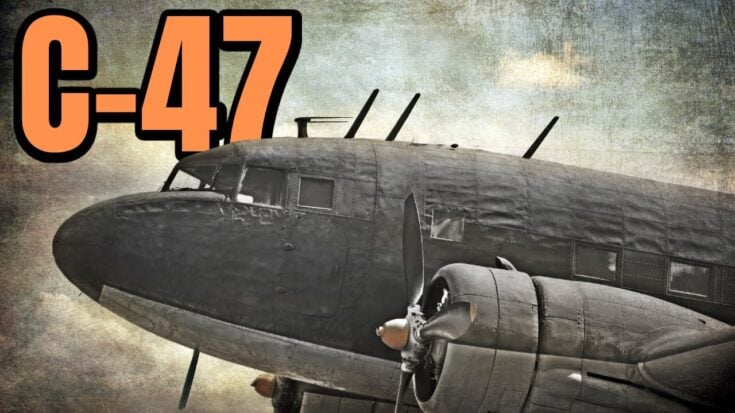
The C-47 Skytrain was the backbone of Allied air transport during World War II. Operating in every major theater, it moved soldiers, supplies, and equipment wherever they were needed. General Dwight D. Eisenhower later identified it as one of the key tools that enabled victory over the Axis powers, a statement that reflected its constant presence behind nearly every major operation.

From Civilian Airliner to Military Transport
The C-47 did not begin as a combat aircraft. Its origins trace back to the Douglas DC-3, a civilian airliner developed in the early 1930s. The DC-3 transformed commercial aviation by offering reliability, range, and efficiency that airlines had never seen before. By the time the United States entered the war in 1941, the aircraft had already proven its value as a dependable long range transport.

Military planners recognized that the DC-3 could be adapted for wartime service. The resulting C-47 featured a reinforced fuselage floor, a large cargo door, and strengthened landing gear for rough airfields. Cargo hooks were added beneath the wing center section, and the tail cone was modified to allow glider towing. Powered by Pratt and Whitney engines, the aircraft could carry up to 28 fully equipped troops or 6,000 pounds of cargo over distances exceeding 1,000 miles.
Supplying a Global War
Throughout the war, the C-47 carried out transport missions across Europe, the Pacific, and beyond. British and Commonwealth forces adopted the aircraft as well, referring to it as the Dakota, short for Douglas Aircraft Company Transport Aircraft. Its reliability allowed Allied planners to build operations around predictable airlift capability.

The aircraft became closely associated with the Normandy invasion. In the early hours of June 6, 1944, C-47s dropped paratroopers behind enemy lines, then spent the rest of the day moving supplies and reinforcements. Similar missions followed across Europe, including critical resupply efforts during the Battle of the Bulge. In the Pacific and the China Burma India theater, C-47s carried men and materiel to remote airstrips and flew supply routes over the Himalayas known as the Hump.
Beyond Transport Duties
The C-47 also served as a medical evacuation aircraft, moving wounded soldiers from front line airstrips to rear area hospitals. More than 10,000 examples were built during the war, with additional variants used by the U.S. Navy under the designation R4D.

After 1945, the aircraft remained in service during the Korean War and played a central role in the Berlin Airlift. One later adaptation stood out during the Vietnam War, when the AC-47 became the first fixed wing gunship, armed with side firing miniguns and known as Spooky or Puff the Magic Dragon.
An Aircraft That Made Victory Possible

The C-47 never relied on speed or firepower. Its importance came from consistency, capacity, and global reach. By keeping armies supplied and mobile, it enabled Allied operations on a scale that would have been impossible without it. That quiet reliability explains why the Skytrain remains one of the most consequential aircraft of World War II.