Inside the Horten Flying Wing
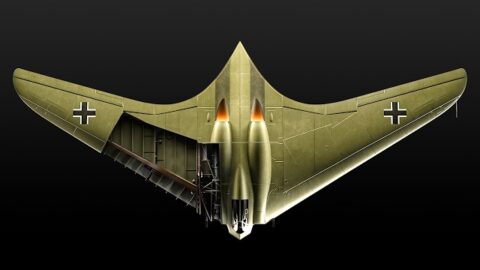
YouTube / Blue Paw Print
During the last years of World War II, German aircraft designers pursued unconventional solutions to regain control of the skies. Among the most ambitious was the Horten Ho 229, a jet-powered flying wing that challenged traditional aircraft design.
Conceived by the Horten brothers, the aircraft eliminated the conventional fuselage and tail in favor of a sleek, blended wing structure. This configuration promised reduced aerodynamic drag, increased speed, and improved fuel efficiency- qualities desperately needed by a Luftwaffe under pressure from Allied air superiority.
Engineering Without a Fuselage
Unlike standard aircraft of the era, the Ho 229’s design integrated the cockpit, engines, and weapons directly into the wing itself. Its twin jet engines were buried within the airframe, while the pilot sat in a small central nacelle. The aircraft was constructed using a mix of steel tubing and layered plywood, bonded together with adhesives and reinforced with charcoal-infused glue. This unique construction method not only conserved strategic materials, such as aluminum, but also contributed to its smooth, aerodynamic profile.
Speed Through Simplicity
By removing vertical stabilizers and reducing surface protrusions, the flying wing minimized drag and turbulence. This enabled the Ho 229 to reach speeds exceeding those of many piston-driven fighters of its time. Its compact shape also reduced its frontal profile, making it a difficult target for both visual and radar detection. These characteristics fueled postwar speculation that the aircraft may have possessed early stealth-like qualities.
Decades later, comparisons between the Ho 229 and the Northrop Grumman B-2 Spirit reignited interest in the aircraft’s potential radar-evading properties. Some historians and engineers have suggested that the wooden structure and smooth curves of the Ho 229 could have absorbed or deflected radar waves. While not intentionally designed as a stealth aircraft by modern standards, its shape and materials may have incidentally reduced its radar cross-section.
Legacy of an Unfinished Machine
Although the Ho 229 never entered operational service before the war’s end, its innovative flying wing concept left a lasting mark on aviation history. Today, it stands as a testament to experimental wartime engineering, an aircraft that foreshadowed future developments in both aerodynamics and stealth technology.