Iranian Strike Reportedly Destroys U.S. ‘Eye in the Sky’ E-3 Sentry at Saudi Air Base
@Osinttechnical / X
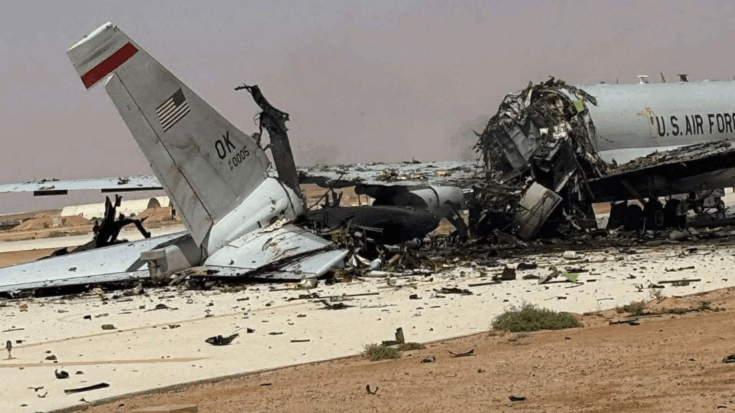
Satellite imagery and official reports suggest that a major Iranian missile and drone strike has severely damaged United States aircraft stationed at Prince Sultan Air Base in Saudi Arabia, including what appears to be the destruction of a rare E-3 Sentry airborne warning aircraft. The incident marks one of the most serious attacks on American air assets in the region in recent years.
Images released in late March 2026 showed visible damage on an aircraft parking apron used by U.S. forces. Analysts studying European Sentinel-2 satellite data detected a strong heat signature on March 27, indicating fires and hot gases rising from the site shortly after the reported strike. The imagery supported early claims that multiple aircraft had been hit during the attack.
Satellite Evidence and Early Reports
Initial assessments focused on aerial refueling planes parked closely together at the base. According to officials cited by The Wall Street Journal, Iranian missiles struck Prince Sultan Air Base and damaged several U.S. refueling aircraft, while drones were also used in the operation. Because available satellite photos were low in resolution, experts could not immediately confirm the exact number of aircraft affected.
Later reporting from Air & Space Forces Magazine and other defense outlets indicated that an E-3 Sentry Airborne Warning and Control System aircraft was among those struck. Photos circulating online appeared to show extensive structural destruction, suggesting the aircraft may be beyond repair. The E-3, sometimes called the military’s “eye in the sky,” serves as an airborne radar and command center capable of tracking aircraft and missiles across vast distances.
Damage to a Strategic Aircraft
The E-3 Sentry is based on a modified Boeing 707 and carries a large rotating radar dome that allows commanders to monitor airspace and direct operations in real time. Only a small number remain in service, making any loss significant for operational planning. Analysts say the aircraft helps coordinate fighters, detect threats early, and manage complex air missions.
Reports indicate that U.S. service members were also injured during the strike, with media accounts placing the number between 10 and 15 personnel. The U.S. Central Command had not issued a detailed public statement at the time of reporting. Earlier in the month, another attack reportedly damaged five refueling aircraft at the same base, though officials then said none were destroyed.
Strategic Importance of Prince Sultan Air Base
Prince Sultan Air Base lies deep inside Saudi Arabia, roughly 600 kilometers from Iran’s coastline. Its inland position has made it a key hub for American air operations, hosting surveillance aircraft, tankers, and intelligence platforms used across the Middle East. The base has supported regional missions since the early 1990s and remains central to air defense coordination.
Because of this role, the installation has faced repeated missile and drone threats during the current conflict period. Officials say several attacks in March targeted aircraft parked in open areas, raising concerns about the vulnerability of large support planes that cannot easily be protected inside hardened shelters.
Lessons From Modern Warfare
Military analysts note that recent conflicts have shown how drones and precision missiles can threaten aircraft even far from front lines. Large planes such as tankers and airborne command platforms require extensive ground space and cannot be hidden easily, making them attractive targets. The strike at Prince Sultan Air Base has renewed debate over whether air forces must disperse assets or move critical aircraft farther from missile range.
Experts also point to parallels with recent wars where parked aircraft were destroyed using coordinated drone and missile attacks. These events have pushed planners to reconsider Cold War-era practices that emphasized dispersal and protective infrastructure. In this case, aircraft remained grouped on open aprons, a decision now under scrutiny as investigators continue assessing the full extent of the damage.