Japan’s Top Secret WW2 Bomber That Was Bigger Than The B-29
YouTube / World War Made Simple
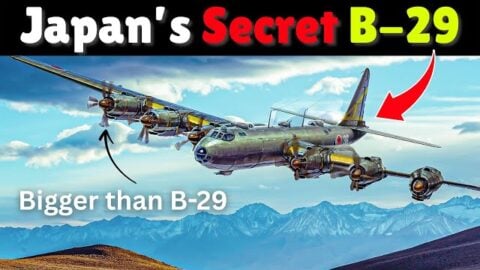
As World War II began to turn decisively against Japan, its military leaders searched for a way to strike directly at American power. The idea was bold, desperate, and deeply unrealistic: attack the continental United States itself. From this ambition emerged one of the most extreme aviation concepts of the war- the Nakajima G10N Fugaku.
The Vision Behind the Fugaku Super Bomber
The Fugaku was conceived as an intercontinental bomber of unprecedented scale. Japanese planners envisioned an aircraft capable of flying more than 11,000 miles without refueling while carrying up to 44,000 pounds of bombs. In its most ambitious form, the bomber would take off from Japan, strike American cities and industrial centers, and then continue onward to land in Nazi-occupied Europe.
To maximize its strategic impact, Fugaku was planned in several versions. One was a conventional heavy bomber designed to devastate U.S. industry. Another was a heavily armed gunship fitted with as many as 40 machine guns for self-defense. The most extreme concept was a transport variant capable of carrying 300 troops, intended to support a proposed invasion of the American West Coast- a plan that reflected more desperation than reality.
Engines That Pushed the Limits of Science
At the heart of the project was a massive technical challenge: propulsion. Engineers proposed using six advanced 36-cylinder engines, each requiring breakthroughs in cooling, materials, and reliability. These engines proved far too complex for Japan’s strained wartime industry, and none ever reached a functional prototype stage.
By 1944, Japan’s situation had worsened dramatically. The loss of Saipan brought American B-29 bombers within range of the Japanese home islands, shifting priorities toward homeland defense. With resources dwindling and the project still years from completion, the Fugaku program was quietly cancelled.
From Failed Bomber to Postwar Legacy
Although the Fugaku never flew, its influence lived on. Many of the engineers involved later played key roles in Japan’s postwar industrial recovery, applying their aeronautical expertise to civilian manufacturing. Their work helped shape Japan’s automotive industry, including companies that would eventually become part of Subaru.
The Nakajima G10N Fugaku stands as one of World War II’s most extraordinary “what if” projects. It symbolizes Japan’s last attempt to achieve strategic parity with the United States through sheer technological ambition- an audacious plan ultimately undone by reality.