Watch Chilean KC-135 Support U.S. F-35s in Landmark Pre-FIDAE Operation
@Lautaro_Chile / X
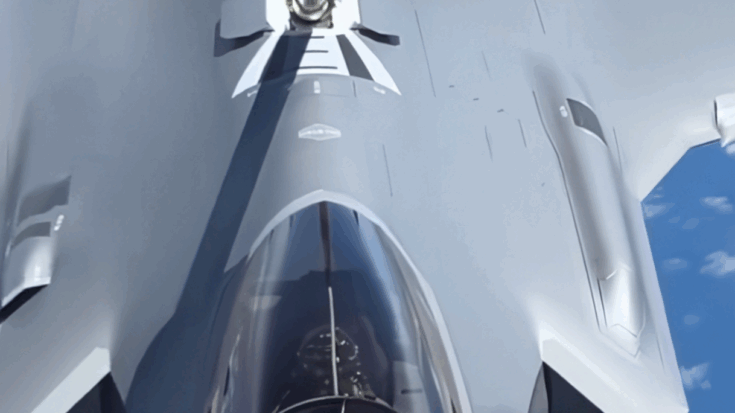
In early April 2026, a routine transit flight turned into a notable moment in modern airpower cooperation when a Chilean Air Force tanker successfully refueled two United States Air Force F-35A fighters over international airspace. The operation supported the aircraft as they traveled to Santiago for the FIDAE 2026 defense exhibition, one of Latin America’s longest-running aerospace events. While aerial refueling between allied nations has occurred for decades, this marked the first confirmed instance of Chilean crews providing fuel directly to the fifth-generation stealth fighters, highlighting how regional air forces have adapted to increasingly advanced aircraft and shared operational standards.
The two fighters belonged to the F-35 Lightning II Demonstration Team, which regularly travels worldwide to showcase the aircraft’s maneuverability and technology. Flight tracking observers noted their arrival at Comodoro Arturo Merino Benítez International Airport on April 4, following a long deployment route supported initially by a U.S. KC-135R tanker from MacDill Air Force Base in Florida. Once the formation reached international airspace near South America, a Chilean KC-135E assumed responsibility. Officials from U.S. Southern Command described the refueling as an example of regional readiness, while Chilean authorities emphasized the professionalism required to coordinate complex operations between different air forces.
Expanding Cooperation in the Western Hemisphere
Chile’s use of the KC-135 dates back to the 2010s, when the country acquired surplus aircraft to extend the range of its combat fleet. Air-to-air refueling remains one of the most demanding aviation tasks, requiring precise flying at high altitude and steady coordination between crews. The ability to support stealth aircraft like the F-35 demonstrates compatibility in communications systems, navigation procedures, and fuel transfer equipment. Such interoperability has become increasingly important as multinational exercises across the Americas have expanded since the early twenty-first century, reflecting a broader emphasis on collective defense planning rather than isolated national operations.
FIDAE itself provides a visible stage for these partnerships. Established in 1980 and held at intervals in Santiago, the exhibition has grown into a major gathering for aerospace manufacturers, defense officials, and military delegations. For 2026, organizers confirmed participation from several modern aircraft, including a U.S. Navy P-8A Poseidon maritime patrol aircraft. Transport platforms such as the Airbus A400M and Embraer KC-390 Millennium also arrived, both viewed as potential candidates for Chile’s future airlift modernization programs as the country evaluates replacements and upgrades for aging logistics fleets.
Strategic Context Behind the Deployment
The presence of advanced American aircraft in Chile reflects wider geopolitical patterns shaping military cooperation in the Western Hemisphere. After years focused heavily on operations in West Asia, U.S. defense planners have renewed attention toward partnerships closer to home, emphasizing joint training and rapid response capabilities. Naval deployments in the Caribbean, including amphibious ships such as USS Iwo Jima and USS San Antonio, have operated alongside regional allies during this period, reinforcing maritime security and disaster response readiness across nearby waters.
Within this environment, aerial refueling missions serve both practical and symbolic purposes. They allow long-distance deployments without reliance on permanent overseas bases while also demonstrating trust between participating nations. For Chile, supporting the F-35 highlighted its growing technical capability and role as a reliable partner in multinational air operations. For observers attending FIDAE 2026, the arrival of stealth fighters backed by allied tankers illustrated how modern airpower increasingly depends on cooperation, shared logistics, and coordinated planning rather than individual national strength alone.