10 Things You Missed in Band of Brothers
YouTube / History vs. Hollywood
Even if you’ve watched Band of Brothers more than once, there’s a good chance you missed some of its smallest but most powerful details. This is not just a war series. It is packed with real history, hidden meaning, and subtle storytelling choices that reward close attention.
Here are 10 overlooked details that make the show even more impressive when you notice them.
10. The “Luger” That Was Not a Luger
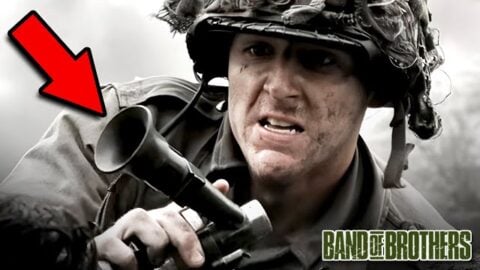
In the chaos of D-Day in Day of Days, Don Malarkey sprints across open ground under heavy fire, aiming for what he believes is a prized German Luger pistol.
It feels like a classic war movie moment, grabbing a trophy weapon under fire. But when he reaches it, disappointment hits instantly. It is not a pistol at all.
What he actually picked up was a German artillery sighting device from a disabled 105mm gun. The moment is so fast that most viewers never question it, but it quietly shows the confusion of battle. Even elite soldiers do not always know what they are grabbing in the fog of war.
9. The “Invisible” Blank Rounds
If you look closely during firefights, you can sometimes spot actors loading blank cartridges into their M1 Garand rifles.
This might seem like a filming mistake, but it actually adds realism. Blanks allow loud gunfire and realistic recoil without danger. The tradeoff is that sharp eyed viewers can occasionally catch the mechanical reality of filming a war scene.
8. The Mystery of Winters’ Letters
Throughout the series, Richard Winters is often shown writing letters in quiet moments away from combat.
For a long time, the show does not explain who he is writing to, which makes it feel like a personal mystery inside a brutal war story.
A closer look reveals the name “Deatta.” This refers to Deatta Alman, a woman Winters met in 1941 in North Carolina. They became close friends and exchanged more than 100 letters during the war. While there was affection between them, their relationship did not continue romantically after the war ended.
7. A Real Soldier Appears on Screen
Edward ‘Babe’ Heffron is portrayed by actor Robin Laing, but the real Babe Heffron actually appears in the series himself.
He can be spotted briefly as a Dutch civilian celebrating during the liberation of Eindhoven in Episode 4. It is a powerful hidden cameo. One of the real men portrayed in the series quietly blends into the story of his own past.
6. Guarnere’s Illness Has a Clear Cause
In Bastogne, William Guarnere complains about intense pain while urinating, describing it in graphic terms. The symptoms strongly suggest gonorrhea, a common wartime infection. The series never directly confirms it, but earlier dialogue mentions a place called “Lulu’s,” implied to be a brothel.
5. Nixon’s Paris Trip Became His Real Love Story
When Lewis Nixon gives Winters a 48-hour pass to Paris, it seems like a simple morale break in the story. But that moment connects to real life. Nixon was visiting Irene Miller, a woman he would later marry in 1946.
Even as his first marriage was falling apart, this wartime relationship grew quietly in the background. His wedding was attended by Richard Winters, his best friend.
4. Tom Hanks Sneaks Into His Own Series
Tom Hanks is heavily involved in Band of Brothers as producer and director, but he also appears briefly on screen. In Episode 5, he plays a British paratrooper, a “Red Devil,” who is rescued by Easy Company. It is a blink, and you will miss it cameo, but fitting. Hanks, who helped shape the series, quietly inserts himself into the story he helped bring to life.
3. The Strange Ritual of the Rifle Sight
In Episode 8, Darrell ‘Shifty’ Powers is seen holding a lighter near the front of his rifle.
This is not random. Soldiers sometimes darkened their sights with soot to reduce glare and reflection in bright or snowy conditions. For a sniper like Shifty, visibility could mean the difference between life and death. This small detail shows just how practical and improvised combat could be.
2. The Song With a Dark Joke
In Episode 9, the men sing “Blood Upon the Risers” while in the field.
At first, it sounds like just another military song, but it is actually a real WWII airborne song known for dark humor.
It tells the story of a paratrooper whose parachute fails. The tone is grim but strangely bonding. Soldiers used humor to cope with constant danger and fear.
1. The “Lucky” Lottery That Was Not So Lucky
One of the most emotional moments in the series is the lottery to send one soldier home.
At first glance, it seems random, but there is a hidden detail. The helmet used appears to contain only one name.
That name belongs to Darrell ‘Shifty’ Powers.
Officers quietly arranged it because Shifty was deeply respected and had never been wounded. It looked like luck, but it was actually a gentle act of favoritism.
But war does not care about fairness. On his way home, Shifty’s transport truck collided with another vehicle driven by a drunk soldier. He survived but suffered severe injuries, while another soldier who had also won a ticket home was killed.