

No Training, No Rank — How a Navy Cook Took an Anti-Aircraft Gun and Fired Back at Pearl Harbor
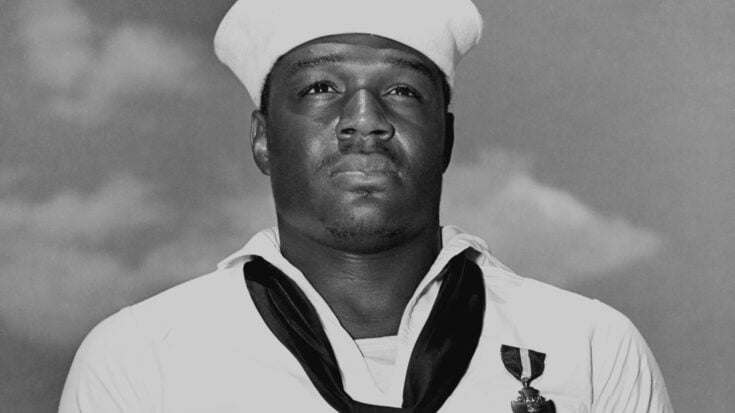
Unknown photographer, US Navy; restored by User:Coffeeandcrumbs, Public domain, via Wikimedia Commons
The morning of December 7, 1941 changed the life of Doris “Dorie” Miller forever and made his actions part of American history. On that day, a surprise attack on Pearl Harbor thrust an ordinary sailor into an extraordinary moment. Miller was not trained for battle, not assigned to fight, and held a position normally far from combat. Yet, faced with chaos and danger, he stepped into a role he had never been taught, helping save lives and fighting back against the assault.
Life Before Pearl Harbor
Doris Miller was born on October 12, 1919, in Waco, Texas, where he grew up working on his family’s farm and playing football in school. In 1939, at age 19, he enlisted in the United States Navy at a time when opportunities for Black men were severely limited. The Navy allowed Black sailors only to serve in mess attendant roles, which meant preparing food, serving meals, and doing laundry for other sailors. These duties were the only ones open to them, and they were not given combat training or higher ranks.
After basic training, Miller was assigned to the battleship USS West Virginia and rose to the rank of mess attendant third class, also training as a ship’s cook. He became known among his shipmates as a strong and reliable crew member and even became the ship’s heavyweight boxing champion.
The Attack and an Unlikely Fighter
On the morning of the attack on Pearl Harbor, Miller was below decks doing laundry when explosions and gunfire shook the harbor. After the alarm sounded, he reported to his assigned battle station only to find it had been destroyed by a torpedo strike. With no formal weapons training and no expectation of combat, he instead went to help where he could. Ordered to aid the wounded, he carried several sailors, including the mortally injured Captain Mervyn Bennion, to places of greater safety.
During the attack, one of the ship’s anti-aircraft guns had no crew available. Without instruction, Miller took control of a .50-caliber Browning anti-aircraft machine gun and began firing at attacking aircraft. He had watched others operate similar weapons, and despite having no formal training, he was able to use the gun effectively until it ran out of ammunition. Sailors later reported that he continued firing until he was ordered to abandon the burning ship as it began to sink.
Recognition and Role in Change
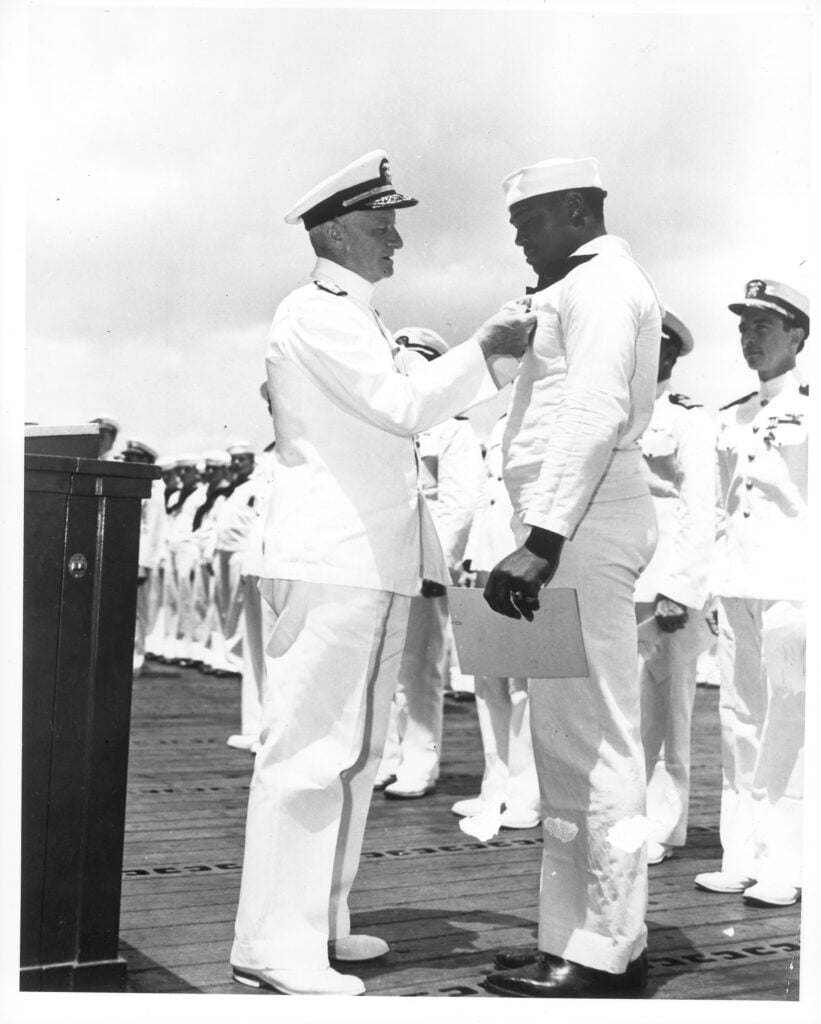
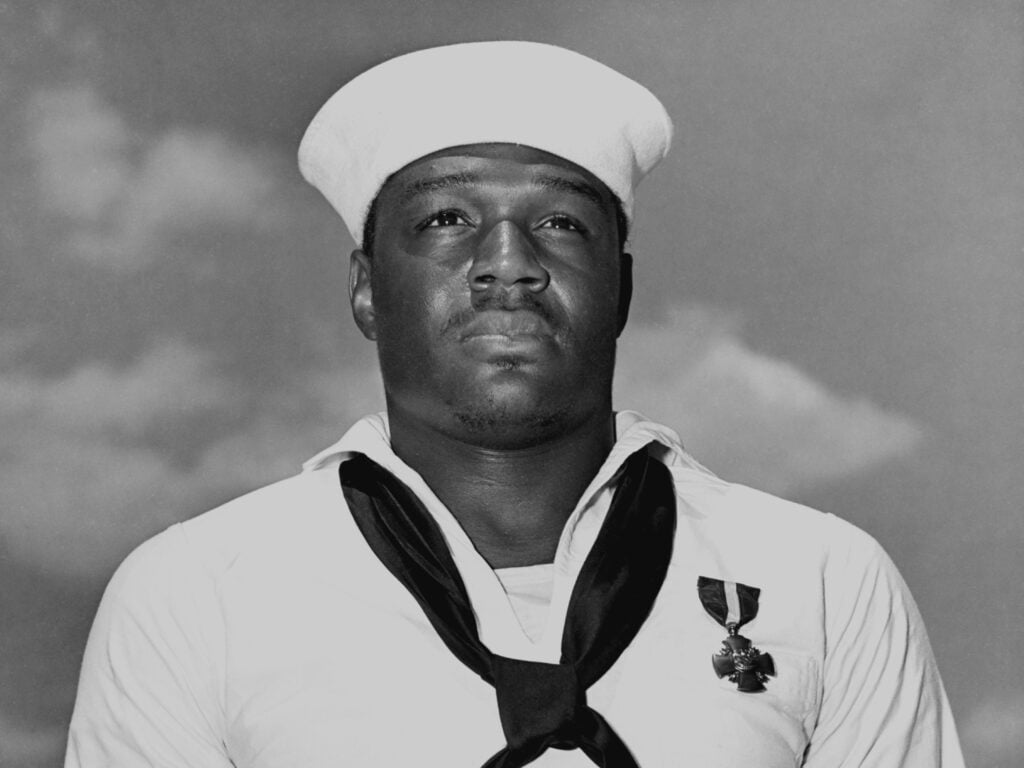
In the months after the attack, Miller’s actions became known across the United States. In May 1942, he was awarded the Navy Cross by Admiral Chester W. Nimitz, commander of the Pacific Fleet, in a ceremony at Pearl Harbor. He was the first Black sailor to receive this decoration, which at the time was the third-highest award for valor in the Navy. His citation praised his devotion to duty, courage, and disregard for his own safety as he helped his shipmates and fired on the enemy.
Miller’s story was widely publicized and used to encourage enlistment and support for the war effort. His image appeared on recruitment posters under the words “above and beyond the call of duty.” This recognition highlighted the bravery of sailors who served despite discrimination and opened discussions within the military about expanding roles for Black service members.
Final Service and Legacy
After his rising fame, Miller returned to active duty. In June 1943 he was assigned to the escort carrier USS Liscome Bay in the Pacific. During operations in the Gilbert Islands on November 24, 1943, the ship was struck by a torpedo from a Japanese submarine. The explosion detonated the ship’s munitions, and the Liscome Bay sank quickly. Over 600 crew members were lost, including Miller, who was declared killed in action.
Miller’s legacy has continued long after his death. The U.S. Navy has honored him with ships named in his memory, including a frigate commissioned in 1973 and a planned aircraft carrier, USS Doris Miller (CVN-81), set to carry his name into the future. These honors reflect the deep respect for his courage under fire and the path he helped open for others in uniform.



_Miller_for_heroism_on_U.S.S._West_Virginia_battleship_(10006683).jpg)