On This Day in WWII (1944): Two P-47 Thunderbolts Collide Midair Over Nebraska, Killing Pilots Beatty and Fanslau
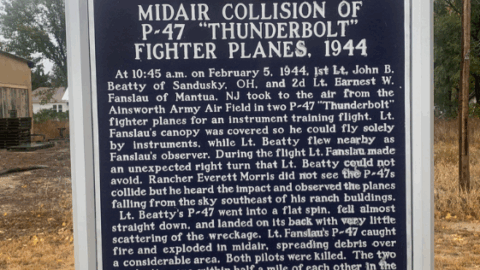
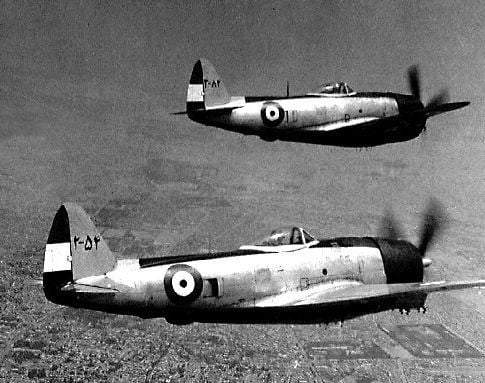
On February 5, 1944, two U.S. Army Air Forces fighter aircraft collided over the Sandhills of Nebraska, ending the lives of two young pilots during a routine training flight. The fighters involved were Republic P-47 Thunderbolts assigned to Ainsworth Army Air Field. The P-47 was a powerful and widely used fighter plane, highly valued for its strength and firepower. Although the U.S. was deep in the middle of World War II by early 1944, not all flying risked combat. Training accidents and aircraft development flights were a regular part of preparing pilots for war, and they sometimes had tragic outcomes.
Training in the U.S. Air Forces
As U.S. forces expanded earlier in the war, many new pilots were trained at fields across the United States. Ainsworth Army Air Field, near the town of Ainsworth in north-central Nebraska, was one of the bases used by the Army Air Forces to prepare fighter pilots for combat duty. Training included long hours in flight and exercises designed to sharpen takeoff, navigation, formation, and aerial maneuver skills. The Thunderbolt was used in advanced stages of training because it was similar in performance to aircraft that pilots might fly in combat overseas.
The P-47 Thunderbolt was a large, single-seat fighter powered by a radial engine. It could carry eight machine guns and was known both for its diving speed and its ability to absorb damage. Students learning to operate this aircraft had to master important skills like flying in close formation, controlling speed in turns, and responding to unexpected changes in aircraft behavior. Mistakes during training sometimes led to accidents, as pilots learned how to handle the powerful and heavy fighter under all conditions.
The Flight on February 5, 1944
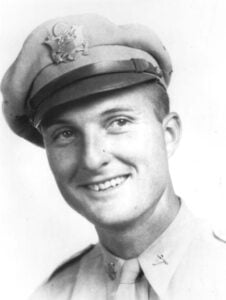
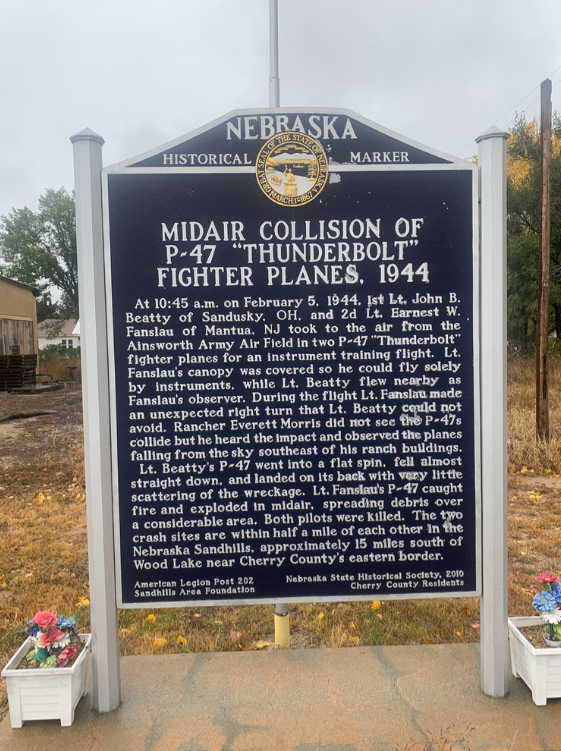
Shortly before 11 a.m. on February 5, 1944, two P-47s lifted off from Ainsworth Army Air Field for a routine training flight over the Nebraska Sandhills. The pilots were First Lieutenant John B. Beatty and Second Lieutenant Earnest W. Fanslau. Both men had completed earlier phases of training and were gaining experience in formation flying and instrument work, which made up an important part of their preparation for operational duty.
During the training exercise, the two fighters were flying together when one pilot made an unexpected turn. According to local reports and historical accounts, the second aircraft was positioned close behind or beside the lead aircraft when the turn suddenly brought the fighters into contact. The propellers and airframes struck one another, and both planes lost control in the thin, cold air above the Sandhills. A nearby rancher reported hearing the collision and then watching both aircraft fall toward the ground.(turn0search7)
The Crash and Its Aftermath
The two Thunderbolts spiraled to the earth and struck the ground about a half-mile apart in the rolling hills. There were no survivors. First Lieutenant Beatty and Second Lieutenant Fanslau were killed either in the collision or upon impact with the ground. The crash visits reported years later found wreckage in small depressions and gullies typical of the Nebraska Sandhills, with local ranchers helping investigators identify crash points long after the event.
Because the fatalities occurred in the United States during a noncombat training mission, they were recorded as part of the Army Air Forces’ accident history. Official accident reports list Fanslau as piloting aircraft 42-8175 from the 53rd Fighter Squadron, 36th Fighter Group, operating from Ainsworth AAB. The details of Beatty’s aircraft are similar, though individual serial data in public records may vary. These records underline that many risks for wartime airmen existed far from the battlefields of Europe and the Pacific.
Training Risks in World War II
Training accidents like the one on February 5 were an unfortunate but well-documented part of air force life during World War II. Thousands of pilots passed through fields in the Midwest, Southeast, and West Coast as the United States prepared to send airmen into combat. The intensity of training schedules, combined with rapidly expanding air fleets and often difficult weather conditions, contributed to accidents even among experienced instructors and students alike. Pilots had to learn to handle new aircraft types, complex controls, and the demands of formation and instrument flight under pressure.
Ainsworth Army Air Field and other training bases remained active through the war, preparing hundreds of pilots for operational units overseas. Stories of accidents from stateside bases remind us that preparation for combat was not without danger. Those killed in training were recorded with honor alongside those lost in combat, and memorials in Nebraska and other states mark where young airmen lost their lives learning the skills that would carry many others to safety and success in the skies over distant battlefields.