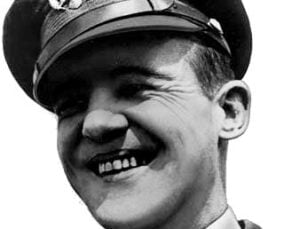
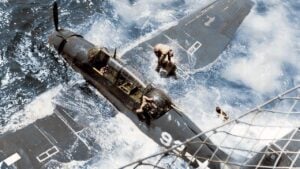
On This Day in WWII (1945): Lt. Louis Curdes Becomes the Only Pilot Awarded for Shooting Down a Friendly C-47
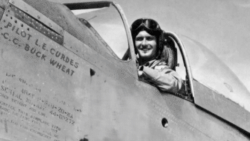
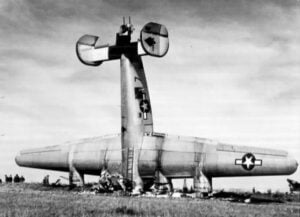
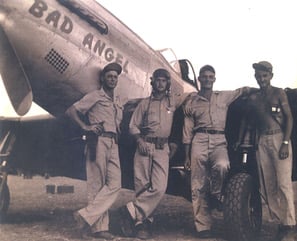
Pima Air and Space Museum., Public domain, via Wikimedia Commons
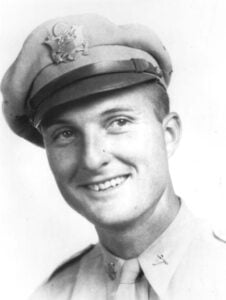
On February 10, 1945, U.S. Army Air Forces pilot Lieutenant Louis Edward Curdes made an extraordinary decision during an aerial mission in the Philippines. While flying his P-51 Mustang over waters near Batan Island, he saw an American C-47 transport plane heading for a Japanese-held airfield. Fearing that the transport and its crew would be captured, Curdes took the drastic step of disabling the aircraft so it would have to ditch in the ocean. This unusual action saved the lives of those on board and earned him the Distinguished Flying Cross. Curdes’s experience reflects the complexity of air operations in the final months of the war.
Early Wartime Service and Pacific Deployment
Louis Edward Curdes was born on November 2, 1919, in Fort Wayne, Indiana, and joined the Army Air Forces, serving in both the European and Pacific theaters. While in the Mediterranean in 1943, he scored several aerial victories against German and Italian aircraft. Later in the war, after recovering from being shot down and held as a prisoner of war in Italy, he requested combat duty in the Pacific and was assigned to the 3rd Air Commando Group.
By early 1945, Curdes was flying the North American P-51 Mustang, a long-range fighter used for escort and ground support missions. On February 7, 1945, he claimed a Japanese Mitsubishi Ki-46 reconnaissance aircraft, adding a Japanese aircraft to his record of victories and making him one of the few American pilots to have downed enemy aircraft from Germany, Italy, and Japan.
The Situation Over Batan Island
On February 10, 1945, Curdes led a flight of four Mustangs from Mangaldan Airfield in the Philippines on a mission to check for a possible enemy airstrip near the southern tip of Taiwan. When they found nothing there, the flight returned toward the Philippines, and Curdes’s section split up with his wingman to the north and the others to the south.
While attacking a small Japanese airfield on Batan Island, Curdes’s squadron mate Lieutenant La Croix was hit by ground fire and forced to land in the sea. Curdes circled overhead to guard him and called for a rescue aircraft. It was during this time that Curdes noticed a larger transport aircraft approaching the airfield, its wheels down and on a direct course for the enemy-held strip.
Recognizing the Dilemma
Curdes looked more closely and saw that the aircraft was a Douglas C-47 Skytrain, a transport widely used by American air forces. He tried repeatedly to contact the C-47 by radio, but there was no response. The transport kept its course and appeared unaware it was headed toward a Japanese position. Curdes also tried flying in front of the C-47 to signal it to turn away, but these attempts failed. It later became clear that the C-47’s radio was malfunctioning and the crew was lost in bad weather, running low on fuel and unaware of their danger.
Faced with the choice of letting the transport and its crew land in enemy hands or forcing it down at sea, Curdes acted. He flew alongside and carefully fired on one of its two engines with his Mustang’s .50 caliber machine guns. When the C-47 continued toward the airfield, he fired on the second engine. With both engines disabled, the transport pilot had no option but to put the aircraft down in the water. The C-47 ditched successfully about 300 yards from shore, and the crew and passengers climbed into lifeboats.
Rescue and Award
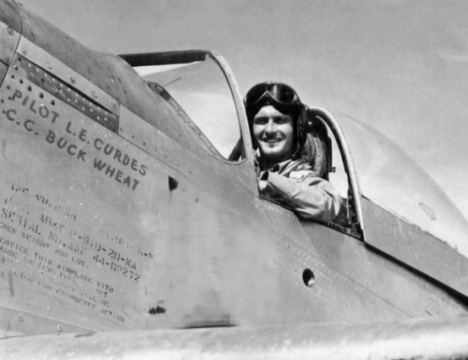
The next morning, Curdes flew cover as a PBY Catalina flying boat came in to rescue the downed airmen. All thirteen occupants of the C-47, including the pilot, crew, and passengers, survived the ordeal and were picked up safely. For his actions in forcing the transport to ditch and ensuring its crew could be rescued rather than captured, Curdes was awarded the Distinguished Flying Cross, a rare honor for what was a unique case of intentional action against a friendly aircraft to save lives.
Curdes added an American flag marking to his P-51 “Bad Angel,” joining other symbols on its fuselage representing his air-to-air victories over German, Italian, and Japanese aircraft. His military career continued after World War II, and he later served in the U.S. Air Force before retiring as a lieutenant colonel.