

On This Day in WWII History (1939): The Aircraft That Became the P-38 Lightning Took Its First Flight

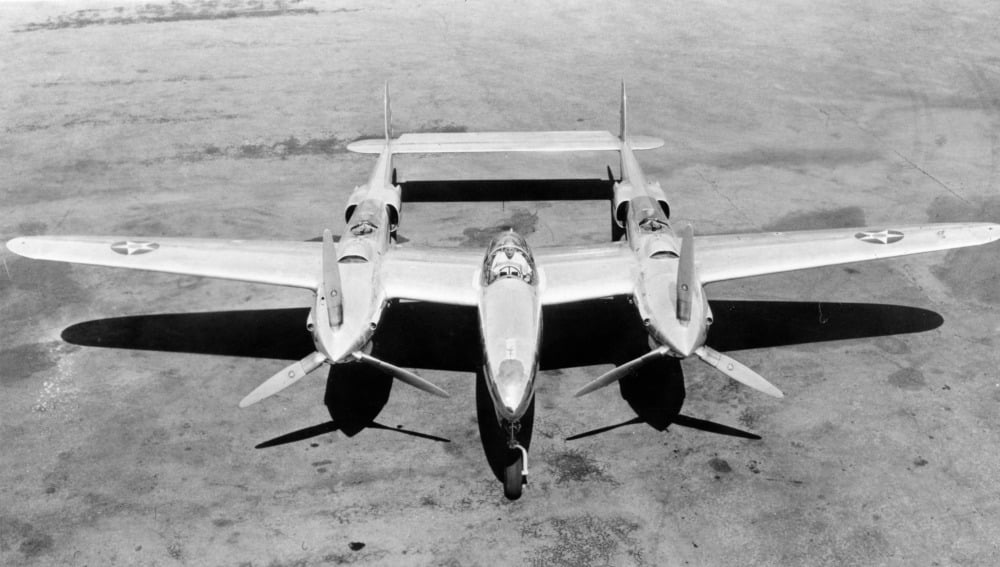
SDASM Archives, Public domain, via Wikimedia Commons
A New Era in Fighter Design
On January 27, 1939, the prototype of what would become one of the most unusual and effective American fighters made its first flight. The Lockheed XP-38 Lightning took to the skies at March Field in California, piloted by First Lieutenant Benjamin S. Kelsey of the United States Army Air Corps. This event marked the start of a long development process for a fighter that would serve throughout World War II.
The XP-38 was the direct result of a 1937 specification from the Army Air Corps that called for a fighter with high speed, strong climb, and heavy armament. Designers Hall Hibbard and Clarence “Kelly” Johnson at Lockheed responded with a radical twin-engine, twin-boom layout that set it apart from nearly all other fighters of the time. The pilot and weapons were housed in a central pod, while two engines sat out on the wing, driving propellers that turned in opposite directions to reduce unwanted torque in flight.
The First Flight and Early Tests
Test pilot Ben Kelsey lifted the XP-38 into the air, but the flight revealed immediate problems. Significant vibrations were felt, and the flaps were moving irregularly due to failed control rods. Kelsey retracted the flaps, which stopped the vibrations, and managed a high-speed landing, though the tail struck the ground as the aircraft came down. After inspection, engineers replaced the broken flap control rods and made other small fixes.
Despite its early issues, the XP-38 showed promise, reaching impressive speeds for its age. Lockheed had funded much of the prototype’s development itself, investing heavily in the design that was still under tight military secrecy. At the time, many aircraft designers had not seen anything like the twin-boom layout, which seemed futuristic compared with the single-engine fighters then in service.
Breakthrough Across the Continent
Just weeks after its first flight, on February 11, 1939, Kelsey piloted the XP-38 on a transcontinental run from March Field in California to Mitchell Field in New York. The aircraft covered the long distance in just over seven hours with two refueling stops, a performance that demonstrated its high speed and endurance even early in its development. Unfortunately, when nearing New York, carburetor icing caused the engines to lose power, and the XP-38 crash-landed short of the runway at a golf course. Kelsey was unhurt, but the prototype was written off.
That February flight played a key role in convincing Army leaders to order a batch of thirteen service test versions of the design, known as YP-38s, in April 1939. Over the next years, Lockheed and the Army refined the aircraft’s engines, aerodynamics, and armament, moving toward a production-ready model.

A Fighter for War
The first production versions of the P-38 entered service in late 1941, not long before the United States entered World War II. Its twin engines and turbo-superchargers gave it range and performance that other American fighters of the time could not match, and its nose armament of machine guns and cannon allowed concentrated fire without gun convergence issues.
During the war the P-38 served in many theatres. In the Pacific it excelled in long-range escort and interception roles, and in Europe its high-altitude performance helped protect bomber formations. Many U.S. aces flew the Lightning, including Richard Bong and Thomas McGuire, who scored dozens of aerial victories in the type.
Legacy of the Lightning
More than 9,900 P-38s of various models were built between 1939 and 1945, making it one of the most produced American fighters of the war. Its first flight on January 27, 1939, set the stage for a distinctive design that combined speed, firepower, and range in a way few other aircraft of the era could match. The Lightning remained in U.S. service through the end of the war, and its innovative layout influenced later aircraft designs.
The P-38’s first flight stands as a reminder of how quickly aviation technology was advancing on the eve of global conflict, and how a new design could reshape expectations for fighter aircraft in the years that followed.


.jpg)
![US Goverment [1]](https://commons.wikimedia.org/wiki/File:Lockheed_XP-38A_in_flight_061018-F-1234P-005.jpg)