

Lockheed’s Overlooked Workhorse of World War II
YouTube / World War Made Simple
On December 8, 1941, three Lockheed Lodestar transports bound for Manila were diverted mid flight as news arrived of the attack on Pearl Harbor. Crewed by civilian pilots under Captain Paul Phelme, the aircraft landed at Nichols Field in the Philippines and were immediately taken over by the Far East Air Force. Within hours, they were flying evacuation and resupply missions under enemy fire. The Lodestar entered World War II not by planning, but by necessity.

Designed to Challenge the DC-3
The Lodestar traced its origins to the Lockheed Model 14 Super Electra, introduced in the late 1930s as a faster alternative to the Douglas DC-3. Designed under the direction of Clarence Kelly Johnson, the Super Electra offered higher speed and longer range but carried fewer passengers and cost more to operate. Commercial airlines favored the DC-3, limiting Lockheed sales.

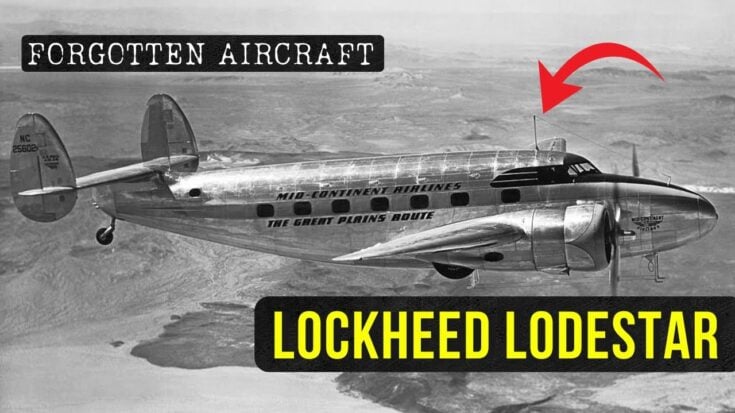
Recognizing the need for a more economical aircraft, Lockheed stretched the Super Electra’s fuselage and created the Model 18 Lodestar. First flown in 1939, it seated up to 18 passengers and improved cost efficiency while retaining speed and performance. Civil certification followed in early 1940, just as global demand for military transports increased.
A Fast Medium Range Military Transport
As the U.S. Army Air Forces expanded, the Lodestar filled a specific niche between small liaison aircraft and larger transports like the C-47. Military variants were designated C-56 through C-60, with the definitive C-60A becoming the primary production model. Powered by 1,200 horsepower engines, the Lodestar cruised at over 220 mph and could outrun many contemporary fighters when lightly loaded.

The aircraft carried troops, towed gliders, and trained paratroopers across the United States. Its single engine performance proved useful in mountainous regions, though its higher wing loading required careful handling on rough airstrips. Crews noted strong speed and range but also reported directional instability in turbulence.
Service Across the Globe
The Lodestar saw combat service in multiple theaters. In the Pacific, early war missions included dangerous supply flights to Corregidor and evacuation sorties under Japanese attack. In Australia, Royal Australian Air Force Lodestars carried wounded personnel across long distances. The Royal Air Force operated the type for transport and clandestine missions into occupied Europe, where speed aided survivability during night operations.

In the China Burma India theater, U.S. forces used C-60As for low altitude supply drops to forward units operating from short and unimproved strips. Canada, South Africa, the Netherlands, and other nations also operated the Lodestar in transport and support roles.
Legacy of a Transitional Aircraft
A total of 625 Lodestars were built across civilian and military variants. After the war, many returned to civilian service as transports, executive aircraft, or agricultural planes. While overshadowed by the C-47, the Lodestar provided speed, range, and flexibility during a critical period when airlift capacity shaped Allied operations.

Its contribution lay in bridging the gap between commercial airliners and dedicated military transports, carrying people and supplies across a global war before quietly leaving the front lines behind.







