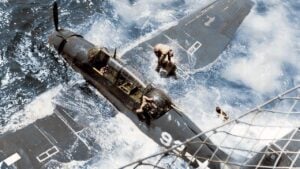
The World War II Tanks That Refused to Leave Service
YouTube / Mark Felton Productions
World War II ended in 1945, but many of its tanks continued in uniform for decades. Some faded quickly due to mechanical limits or small production runs. Others remained active into the twenty first century, serving in wars, reserves, and even ceremonial roles.
Germany’s Early Exit
The first major types to disappear were Germany’s heavy tanks. The Tiger I and Tiger II left service in May 1945. No postwar army adopted them. Complex engineering, reliability issues, and limited production prevented further use.

The Panther lasted slightly longer. France operated about 50 captured vehicles with its 503rd Armored Regiment before retiring them in 1952.
Asia’s Postwar Holdovers
In China, Japanese armor formed the backbone of early postwar forces. The Type 97 Chi-Ha and Type 95 Ha-Go remained in use into the early 1950s before replacement by Soviet designs.

Finland operated captured T-26 tanks longer than the Soviet Union itself, retiring the last examples in 1961 after using them as fixed defensive positions.
Cold War Survivors
The American M26 Pershing left United States service in 1951 but continued with Italy until 1963. Germany’s Panzer IV fought again under Syrian colors during the Six-Day War. Bulgaria retained others as static bunkers into 1989.

Two Allied workhorses endured into the late 1960s. Ireland phased out the Churchill tank by 1969. Brazil retired its last M3 Lee the same year.

Turkey held onto the Valentine tank until 1974 in bridge laying form. The Soviet IS-2 remained in reserve service into the mid 1990s, while the IS-3 appeared in Egyptian service into the 1980s.

Into the Twenty First Century
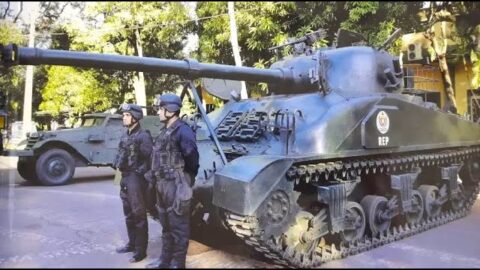
South America proved a final refuge for wartime armor. Paraguay retired upgraded M4 Sherman and M3 Stuart tanks in 2018. Uruguay withdrew its M24 Chaffee in 2019. Myanmar paraded its last Comet tank in 2021.

As of 2026, two World War II designs remain in official service. Thailand keeps a ceremonial Type 95 Ha-Go in running order. More significantly, the T-34-85 still appears in reserve or static roles in several nations, including North Korea and Vietnam.

More than eighty years after the war, the T-34 continues to serve. Its combination of simplicity, durability, and wide production ensured that it outlasted almost every contemporary design.