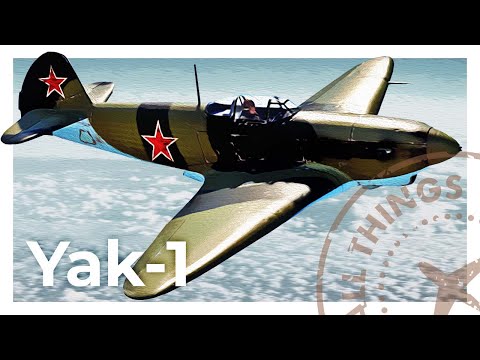
The Soviet Pilots’ Favorite WW2 Plane
YouTube / AllthingsWW2
The Yak-1 arrived at the darkest hour of the war. As German forces surged toward the Soviet Union in 1941, this lean, fast-climbing fighter was rushed into combat with barely time for refinement. What it lacked in polish, it made up for in heart- agile, forgiving, and ideal with the brutal, low-altitude battles of the Eastern Front.
Pilots embraced it not because it was flawless, but because it defied the odds. From those desperate first encounters was born an entire family of fighters that would dominate Soviet skies, with more than 35,000 Yaks ultimately built. The Yak-1 wasn’t just an aircraft- it was the beginning of an air war dynasty.
Born on the Brink
When Nazi Germany launched Operation Barbarossa in June 1941, the Soviet Air Force was caught in chaos. Hundreds of outdated aircraft were destroyed on the ground, and the Luftwaffe seemed unstoppable. Into this desperate moment stepped a new fighter: the Yakovlev Yak-1.
It was not perfect, and it arrived in limited numbers at first. But it was modern, fast, and most importantly, adaptable. As the Soviet Union fought for survival, the Yak-1 quickly became more than just another aircraft. It became a lifeline.
A Modern Fighter for a Modern War
Designed by Alexander Yakovlev’s bureau, the Yak-1 was a sleek, single-engine monoplane powered by the Klimov M-105 inline engine. It featured a lightweight mixed construction of wood and metal—practical for a nation whose aluminum supplies were under constant strain.
The aircraft combined good speed with excellent maneuverability at low and medium altitudes, exactly where much of the fighting on the Eastern Front took place. Armed typically with a 20 mm ShVAK cannon firing through the propeller hub and two 7.62 mm machine guns, it delivered respectable firepower for its time. Unlike some Soviet fighters that were rushed into service with severe flaws, the Yak-1 evolved steadily. Early production problems were addressed, performance improved, and pilots gained confidence in the machine.
Forged in Combat
The Yak-1 proved itself in the brutal air battles over Moscow, Stalingrad, and Kursk. It could not always outmatch German fighters like the Bf 109 in raw performance, especially at higher altitudes. But it did not need to dominate every statistic to succeed. On the Eastern Front, engagements were often fought below 5,000 meters. Here, the Yak-1 was agile, responsive, and deadly in capable hands. Soviet pilots learned to exploit its strengths- tight turns, quick acceleration, and solid low-altitude performance.
As experience grew, so did its reputation. Many Soviet aces, including Lydia Litvyak and other members of the famed 586th Fighter Aviation Regiment, flew variants of the Yak-1 with distinction. The aircraft became closely associated with the Red Air Force’s resurgence after the disastrous opening months of the war.
The Pilot’s Aircraft
What truly set the Yak-1 apart was how it felt in the cockpit. Soviet pilots consistently described it as balanced and forgiving. Controls were harmonious, visibility was decent for its class, and it responded predictably in combat maneuvers. Compared to some earlier Soviet designs, which could be heavy or unstable, the Yak-1 inspired trust. In the chaos of dogfights over the steppe, that trust meant survival. It was an aircraft that rewarded skill rather than punishing mistakes harshly.
The Yak-1 also formed the backbone of an entire family of fighters—the Yak-7, Yak-9, and ultimately the superb Yak-3. More than 35,000 Yak-series fighters would be built during the war, and it all began with the Yak-1.
A Symbol of Recovery
The Yak-1 was not the fastest fighter of World War II. It was not the most heavily armed, nor the most technologically advanced. But it arrived when the Soviet Union needed it most and matured alongside the Red Air Force itself.
As factories were evacuated eastward and rebuilt under extreme conditions, the Yak-1 rolled off production lines in increasing numbers. It helped wrest air superiority back from the Luftwaffe and supported the Red Army’s long push westward to Berlin. In the end, the Yak-1 earned its place not through flashy innovation but through reliability, adaptability, and the faith of the men and women who flew it. It was, above all, the Soviet pilots’ favorite and the foundation of a fighter dynasty that helped turn the tide of war.