Why the Me 410 Terrified Bomber Crews in 1944
YouTube / Dark Skies
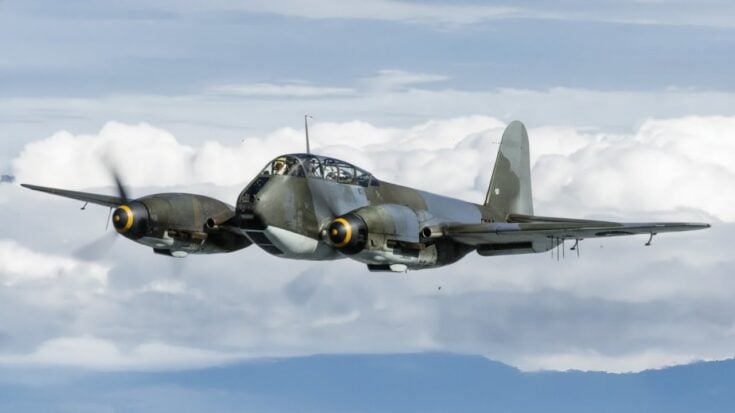
High over the North Sea, American bomber formations once faced a threat that did not rely on agility or dogfighting skill. It relied on mass, speed, and brute firepower. That threat was the Messerschmitt Me 410 Hornet, the final and most refined attempt to make Germany’s heavy fighter doctrine work under the pressure of a losing air war.

The Destroyer Idea
Before the war, Luftwaffe planners believed future air battles would be decided by range and firepower rather than maneuver. This thinking produced the Zerstorer concept, a twin engine fighter designed to escort bombers, intercept enemy aircraft, and strike ground targets independently. Early designs appeared promising on paper and seemed to confirm German doctrine during the campaigns over Poland and France.

The illusion collapsed during the Battle of Britain. The Bf 110, Germany’s first true destroyer, proved vulnerable once combat tightened. RAF fighters exploited its size and poor turning ability, and losses mounted quickly. Yet instead of abandoning the idea, German leadership demanded a better version.
Failure Before Success
Messerschmitt’s Me 210 was meant to correct the Bf 110’s flaws. It did the opposite. Severe instability plagued the aircraft, leading to crashes that killed crews during training. Political pressure forced production to continue despite warnings from test pilots. Hundreds were built, few were trusted, and the program became a symbol of institutional pride overriding operational reality.

Only after years of redesign did Messerschmitt finally solve the problem. The Me 410 emerged with corrected wing geometry, a lengthened fuselage, reinforced tail surfaces, and more powerful DB 603 engines. For the first time, Germany had a heavy fighter that handled predictably and performed as intended.
A Bomber Killer Arrives Too Late
Entering service in 1943, the Me 410 was fast, stable, and heavily armed. Its nose mounted multiple 20 mm cannons, some installed in the internal bomb bay, giving it a devastating head on punch against American bombers. Early encounters over northern Germany showed what the design could do when bomber escorts lacked range.

The most extreme version carried the BK 5 50 mm cannon, a weapon adapted from a tank gun. One hit could destroy a B 17 outright. Crews fired from beyond defensive gun range, breaking formations with single shots. For a brief period in early 1944, Me 410 units claimed significant bomber losses.
Outpaced by the Future
The Hornet’s moment was short. Long range Allied escorts, especially the P 51 Mustang, erased the distance advantage the Me 410 depended on. Heavy fighters became easy targets once intercepted, regardless of firepower. Losses mounted faster than Germany could replace aircraft or trained crews.

By mid 1944, fuel shortages and Allied air superiority ended the destroyer force. The Me 410 was abandoned just as jet fighters like the Me 262 proved where air combat was heading. The Hornet stood as a technically capable aircraft built for a doctrine that no longer matched reality.