The Bomber That Was Loaded with the Strangest Bombs of WW2
YouTube / Dark Skies
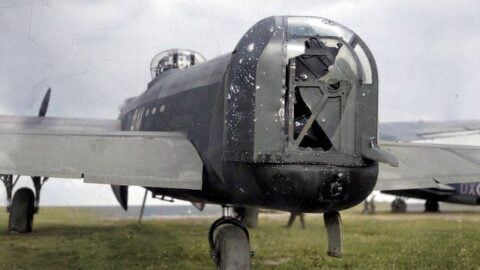
During World War II, Britain’s Bomber Command relied heavily on the Avro Lancaster, a powerful and highly adaptable heavy bomber. With its large bomb bay and exceptional carrying capacity, it could deliver both massive conventional bomb loads and a range of experimental weapons.
From strategic raids deep into enemy territory to innovative special missions, the Lancaster became the backbone of Britain’s bombing effort and a platform for some of the most unusual weapons of the war.
The Lancaster and Britain’s Heavy Strike Power
The United Kingdom’s Bomber Command often faced missions that demanded more than conventional firepower. Whether targeting heavily defended German industrial zones or legendary warships like the Tirpitz, they turned to one aircraft above all others, the Avro Lancaster. With its enormous bomb load and remarkable versatility, it became the platform for some of the most unusual and innovative weapons of World War II.
A Heavy Bomber Built for Adaptation
The Avro Lancaster entered service as one of the most capable heavy bombers of the war. Powered by four Rolls-Royce Merlin engines, it could reach speeds of around 287 miles per hour while carrying bomb loads that exceeded 18,000 pounds.
Its design featured a long, uninterrupted bomb bay that allowed engineers to adapt it for experimental payloads far beyond standard high explosive bombs. This flexibility made it ideal for specialist missions from precision strikes against hardened targets to experimental weapons testing that pushed the limits of aerial warfare.
Striking the Tirpitz and the Industrial Heartland
British planners used the Lancaster in some of the most daring operations of the war. Against the German battleship Tirpitz, known as the “lonely queen of the north,” bombers repeatedly attempted to neutralize the threat it posed to Arctic convoys.
The aircraft also played a central role in attacks on the industrial heartlands of the Ruhr Valley, where dams and factories powered much of Germany’s war production. These missions required not only strength but innovation in weapon design, leading to the creation of specialized bombs capable of bypassing heavy defenses and striking vulnerable infrastructure deep inside enemy territory.
Operation Chastise and the Bouncing Bomb
The most famous Lancaster mission was Operation Chastise in May 1943. Nineteen specially modified aircraft of 617 Squadron took off at low altitude on a night raid that would become legendary. They carried Barnes Wallis’s revolutionary “bouncing bomb,” officially known as the Upkeep mine, designed to skip across water, avoid torpedo nets, and detonate against dam walls.
The raid targeted key dams in Germany’s industrial region, aiming to disrupt power and water supplies critical to wartime production. Flying at treetop height under intense fire, the crews demonstrated extraordinary precision and courage, and although several aircraft were lost, the mission achieved significant damage and became one of the most studied operations in air warfare history.
Earthquake Bombs and Radical Innovation
The Lancaster also carried some of the strangest bombs ever developed during the war. Barnes Wallis later designed the “earthquake bombs” Tallboy and Grand Slam, massive weapons intended to penetrate deep underground before detonating, shaking enemy structures apart from within.
Smaller experimental weapons, such as the Highball spinning bomb, were also tested for naval attacks. These innovations demonstrated how the Lancaster became more than a bomber, evolving into a platform for radical weapons that reshaped strategic bombing and influenced postwar aircraft design.