The Weirdest Plane of WWII
YouTube / Today I Found Out
In August 1944, only weeks after the Allied landings in Normandy, two Royal Canadian Air Force airmen were flying a routine patrol that would turn into something far more unusual. Flight Lieutenant Walter Dinsdale and Pilot Officer Jack Dunn were piloting a de Havilland Mosquito heavy fighter over the invasion beaches when they noticed something odd in the distance.
At first glance, neither man could make sense of what they were seeing. The aircraft had the general outline of a German bomber, but something was clearly wrong. As Dinsdale later recalled, it looked like a Junkers Ju-88, but an additional structure mounted on top defied explanation. “I thought it was one of their glider bombs mounted in a new way,” he said. “It was on top, mounted between the rudder and the main wing.”
A Target First, Questions Later
In the heat of combat, there was little time to puzzle over unusual silhouettes. Whatever it was, it was German, and that was enough. The Mosquito crew closed in and engaged without hesitation. The strange aircraft was slow, awkward, and easy to track.
Dinsdale described it as lumbering through the sky at roughly 150 miles per hour, an easy target for a fast Allied fighter. “It was retribution for Jerry for thinking up such things,” he later said. Within moments, the Mosquito’s fire tore into the aircraft, bringing it down over occupied France.
At the time, the Canadians had no idea they had just destroyed one of the most bizarre weapons systems of the Second World War. The truth only emerged later, revealing that what they had shot down was not a conventional bomber at all.
The Mistel: A Flying Piggyback Weapon
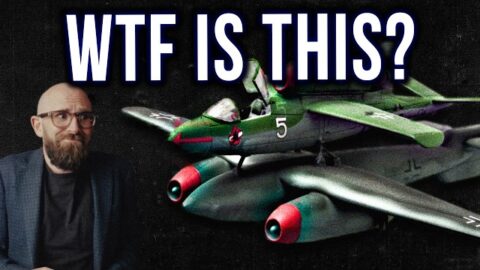
The aircraft was part of a German experimental system known as the Mistel, or “mistletoe.” It was one of the strangest concepts developed by Nazi Germany in the later stages of the war, when desperation pushed engineers toward increasingly unconventional ideas.
The Mistel combined two aircraft into a single weapon. A heavily modified bomber, usually a Junkers Ju-88, was packed with explosives and turned into a massive flying bomb. Mounted on top of it was a smaller fighter aircraft, typically a Messerschmitt Bf 109 or Focke-Wulf Fw 190. The fighter carried a pilot who controlled the entire combination during flight. Once the pair reached the target area, the pilot would aim the explosive-laden bomber toward its objective, detach it, and then escape in the fighter. The unmanned bomber would continue on a guided trajectory before detonating on impact.
Innovation Born From Desperation
The Mistel concept was ambitious, even ingenious in a dark way, but it came too late in the war to make a meaningful impact. By the time it was deployed, Germany was already on the defensive, struggling with fuel shortages, pilot losses, and overwhelming Allied air superiority.
Although a handful of Mistel operations were carried out, they achieved limited success. The complexity of the system, combined with the increasingly chaotic state of the Luftwaffe, meant that the weapon never fulfilled its original promise.
A Curious Footnote in Air War History
For the Canadian pilots over Normandy, the encounter was just another enemy aircraft to be shot down. Only later did they learn that they had destroyed one of the most unusual aviation experiments of the war. The Mistel remains a striking example of wartime innovation pushed to extremes- an unusual “piggyback” aircraft that reflected both technical creativity and strategic desperation in the final years of the conflict.