Why Anti Aircraft Guns Failed Over London in 1940
YouTube / Real Engineering
On September 15, 1940, the Luftwaffe launched one of its largest attacks of the war, sending more than 1,100 aircraft toward London. The objective was not simply destruction. German planners aimed to draw out Royal Air Force fighters and destroy them in a decisive clash, clearing the way for a future invasion of Britain.

Below, anti aircraft batteries fired continuously. In a single month, one division defending the Thames Estuary expended over 250,000 shells. Yet results were limited. On average, it took thousands of rounds to bring down a single aircraft.
Why Anti Aircraft Fire Struggled
The problem was not a lack of firepower but a lack of precision. Anti aircraft crews relied on visual tracking to estimate an aircraft’s speed, altitude, and direction. Gunners aimed not at the aircraft itself, but at where they believed it would be when the shell arrived.

Every factor worked against them. Aircraft changed course and altitude frequently. Shells required carefully timed fuzes, set manually before firing. Even a small miscalculation meant the shell would explode too early or too late.
At high altitude, the challenge increased further. Aircraft were harder to see, and small errors in estimation translated into large misses. The result was a system that depended on volume rather than accuracy.
The Search for a Solution
Engineers understood that anti aircraft fire needed a way to detect proximity to a target automatically. Early attempts to develop radar triggered fuzes failed. The electronics of the time were fragile, and many believed no device could survive the extreme forces of being fired from a gun.

Both Britain and Germany abandoned the concept. The United States continued the effort, driven by heavy losses to air attack in the Pacific.
The Breakthrough of the VT Fuze
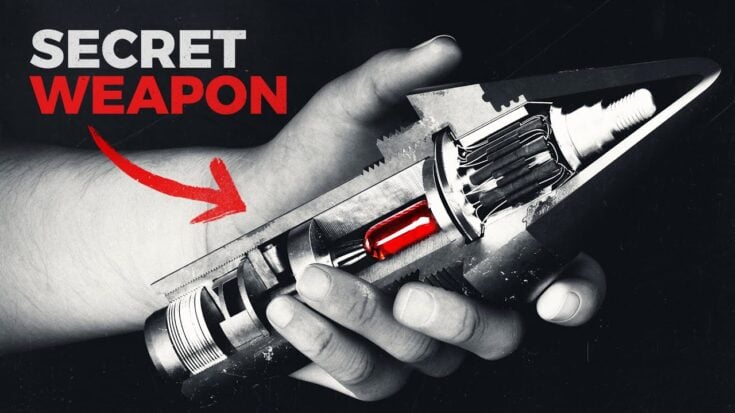
The solution came in the form of the VT Fuze, a compact radio proximity device built into an artillery shell. It used a small radar transmitter and receiver to detect nearby objects. When the reflected signal reached a certain threshold, the fuze detonated the shell automatically.

Powering the device required an unusual approach. Engineers designed a miniature battery activated only after firing. A sealed glass vial containing liquid electrolyte shattered under the force of rotation, allowing the battery to function only in flight. This prevented accidental detonation and allowed long term storage.

The fuze also accounted for relative motion using the Doppler effect. As a shell approached an aircraft, changes in signal frequency triggered detonation at the optimal distance, maximizing fragmentation damage.
A Transformation in Air Defense
The impact was immediate and measurable. During the early war, anti aircraft guns might require over 1,000 rounds to destroy a single aircraft. With the VT fuze, that number dropped to roughly 100 rounds.

This improvement changed naval warfare in the Pacific. Ships equipped with proximity fuzes could engage attacking aircraft far more effectively, contributing to the defense against mass attacks.
Later in the war, the technology was introduced in Europe. During the defense against V-1 flying bomb attacks, a large percentage of incoming missiles were destroyed before reaching their targets. The same principle proved effective in ground combat, where airburst artillery became far more lethal.