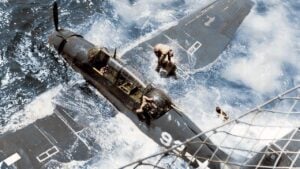
The WWII Plane the Navy Regretted Building: Curtiss SO3C Seamew
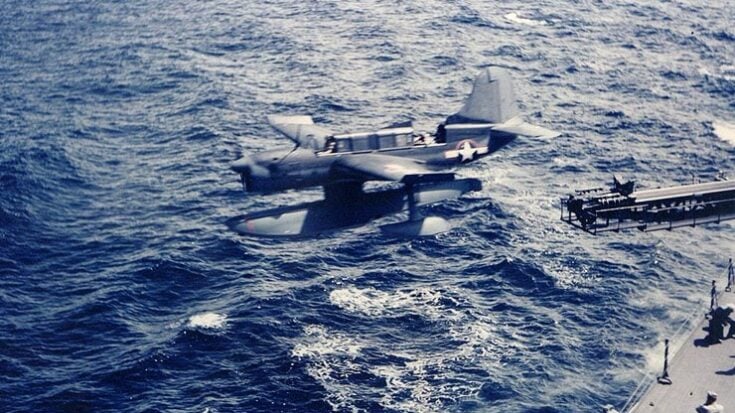
U.S. Navy, Public domain, via Wikimedia Commons
The Curtiss SO3C Seamew was meant to modernize naval scouting during World War II, yet it quickly became a source of regret for the United States Navy. Designed to replace the older SOC Seagull, it promised higher speed, longer range, and flexible use from ships or land bases. On paper, it appeared to meet every demand placed on it. In practice, the aircraft revealed how strict requirements and untested technology could undermine even a well-funded program.
Work on the Seamew began in 1937, when the Navy asked Curtiss and Vought to design a faster catapult scout plane. The specification demanded a mid-wing monoplane with folding wings, a two-man crew, and a removable float that could be swapped for wheels. Weight limits were tight, and storage space aboard cruisers shaped every choice. Most critical was the required engine, a new Ranger inverted V-12 that had not yet proven itself.
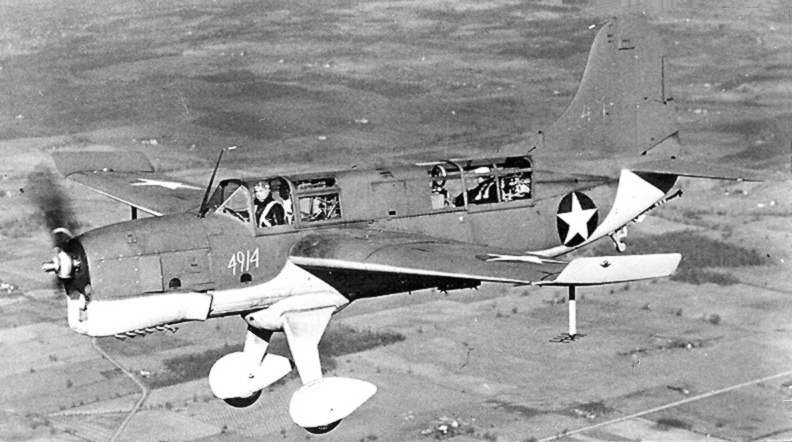
Design and Early Development
Curtiss submitted its proposal in mid-1937 and soon received a prototype contract, as did Vought. The Curtiss design became the XSO3C-1 and first flew in October 1939. It used all-metal construction, abandoning fabric surfaces for stressed aluminum skin. Early trials showed performance close to its rival, and although the Vought aircraft was slightly faster, it was heavier. The Navy chose the Curtiss design and ordered hundreds before final testing was complete.
Serious trouble appeared during Navy trials in 1940 and 1941. The Ranger engine suffered from overheating and failed repeatedly, once forcing the prototype to sink after an emergency landing. Stability issues also worried pilots, especially during low-speed handling. Curtiss sent the aircraft to Langley Field for wind tunnel work, where engineers enlarged intakes, added cowl flaps, and reshaped the tail. These fixes reduced danger but never fully solved the core problems.
Production and Service Use
Despite doubts, production moved forward in 1942 under the name SO3C, called Seamew by Curtiss. The Navy confusingly reused the Seagull name, creating later confusion with the older SOC. The first model carried light armament, with one forward machine gun, one defensive gun, and small bomb racks. Later versions added arrestor gear, depth charge capability, and a slightly stronger engine. None of these changes addressed the aircraft’s basic flaws.
Operational use quickly exposed new failures. Fully fueled Seamews often could not take off from water, defeating their scouting role. In rough seas, the central float flexed enough for the propeller to strike it, damaging both parts. Takeoff angles were steep and left pilots briefly without roll control. Accidents mounted, and confidence in the aircraft collapsed across the fleet.

Withdrawal and Aftermath
The Navy withdrew the Seamew after only short service periods, sometimes lasting just weeks on a ship. Ironically, the older SOC Seagull returned to duty to replace it. Attempts to reuse the aircraft as radio-controlled target tugs failed due to weak engine power. The program became a lesson in how rushed production can magnify early mistakes.
Under Lend-Lease, several hundred Seamews went to the British fleet, where they earned an unflattering reputation and the nickname “sea-cow.” Most ended their days as trainers or target aircraft in Canada. The Seamew’s story did not reflect poor effort by its builders alone. Instead, it showed the risk of forcing experimental engines and strict rules onto a single design.
Its eventual replacement, the Curtiss SC Seahawk, corrected many of these issues by using proven powerplants and looser limits. By comparison, the SO3C stands as an example of ambition outrunning reality. It remains one of the clearest cases where meeting written demands failed to meet real naval needs.
Its brief service life left little physical trace, yet its record survives in naval reports and pilot accounts today.