

U.S. Deploys Heavy B-52 Bombers Directly Over Iran for First Time in Conflict
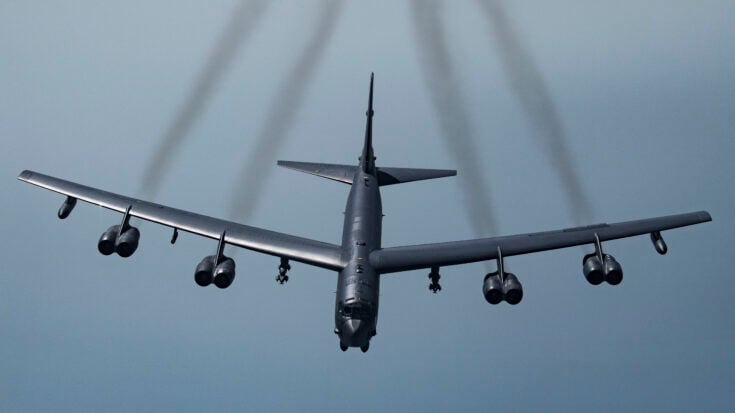
Photo by Senior Airman Keifer Bowes, Public domain, via Wikimedia Commons
A New Phase in the Air Campaign
Modern conflicts are often defined by changes in strategy rather than single battles. In late March 2026, the United States introduced a major shift in its ongoing military campaign against Iran when B-52 Stratofortress bombers began flying direct overland missions across Iranian territory for the first time since fighting began under Operation Epic Fury.
At a Pentagon briefing, Chairman of the Joint Chiefs of Staff Gen. Dan Caine confirmed the development, stating, “Given the increase in air superiority, we’ve successfully started to conduct the first overland B-52 missions, which allow us, as we’ve before, to continue to get on top of the enemy.” The announcement marked a transition from earlier long-range strikes launched outside Iranian airspace to operations conducted directly overhead.
Operation Epic Fury Expands
Operation Epic Fury began on February 28 as a joint military effort aimed at weakening Iran’s military infrastructure and limiting its ability to launch attacks beyond its borders. According to U.S. officials, more than 11,000 targets were struck within the first 30 days of the campaign, including missile facilities, logistics networks, and naval assets. The scale reflects one of the largest sustained air operations in recent decades.
Caine said joint forces remained focused on defined military goals, explaining that operations were designed to “systematically continue to degrade and destroy Iran’s ability to project power and threaten civility beyond its borders.” U.S. defense leaders also reported the destruction of more than 150 Iranian naval vessels during the campaign, indicating heavy pressure on maritime capabilities tied to regional operations.
Why the B-52 Matters
The B-52 Stratofortress is one of the oldest aircraft still serving in active military roles, first entering service during the Cold War. Despite its age, the bomber remains effective because of its long range, large payload capacity, and ability to carry precision-guided weapons. During Operation Epic Fury, B-52 aircraft have launched cruise missiles and conducted coordinated strikes alongside fighters, drones, and electronic warfare platforms.
Military analysts often view the deployment of such bombers as a signal that air defenses have been significantly reduced. Earlier phases of the conflict relied more heavily on stealth aircraft and stand-off weapons. The shift to visible heavy bombers flying directly overhead suggests commanders believe conditions now allow larger aircraft to operate with lower risk compared to the opening days of the campaign.
Regional Escalation and Retaliation
The broader conflict has triggered military responses across the Middle East. Iranian forces have launched drone and missile attacks toward Israel, Jordan, Iraq, and Gulf states hosting American military installations. These strikes have caused casualties, infrastructure damage, and disruptions to aviation routes and energy markets, increasing global concern over regional stability.
Defense Secretary Pete Hegseth acknowledged that missile launches from Iran continue but stated that interception systems remain active, saying Iran may still fire “some missiles, but we will shoot them down.” He added that the previous 24 hours recorded the lowest number of incoming missiles and drones since the operation began, suggesting pressure from sustained air operations may be affecting launch capacity.
Historical Context of Strategic Bombers
Historically, the B-52 has played roles in conflicts ranging from Vietnam to operations in the Middle East and Afghanistan. Its continued use highlights how long-range bombers remain relevant even in an era dominated by stealth aircraft and advanced sensors. The aircraft’s endurance allows missions lasting many hours, often supported by aerial refueling and coordinated command systems.
Within Operation Epic Fury, the bomber’s presence reflects a combination of military signaling and operational practicality. Heavy bombers can deliver large numbers of precision weapons during a single sortie, allowing commanders to sustain pressure while reducing the number of separate missions required. As the campaign continues, the use of different aircraft types shows how airpower adapts as battlefield conditions change.




.jpg)