Watch Stunning Multi-Generation Fighter Formation Featuring WWII Icons and an F-14
EFP Network / YouTube
Dale “Snort” Snodgrass and the Grumman Cats Flyby of 1995
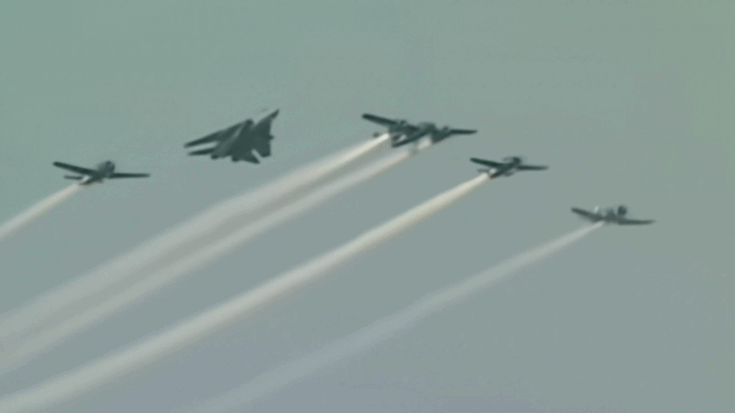
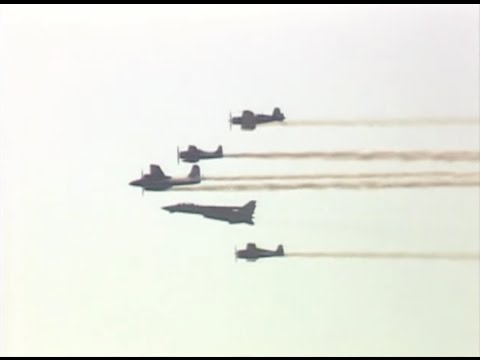
Air shows have long served as living museums, where aircraft from different generations share the sky and remind audiences how aviation evolved across decades. One memorable moment occurred during the Wings of Eagles Final Victory Air Show in 1995 at the National Warplane Museum in New York. There, spectators witnessed an unusual formation that linked the piston-engine fighters of the Second World War with the jet age through the skill of a single pilot, Dale “Snort” Snodgrass.
The event featured several aircraft built by Grumman, a company often called the “Grumman Ironworks” because of its reputation for designing durable naval fighters. Flying displays began with solo demonstrations by the F8F Bearcat, F6F Hellcat, and F7F Tigercat. Each aircraft represented a different stage in American carrier aviation, from late-war propeller fighters to designs created as naval aviation prepared for faster and heavier aircraft.
Warbirds Meet the Jet Age
The performance gained new attention when Snodgrass entered the scene flying an F-14A Tomcat, one of the most recognizable carrier-based fighters of the Cold War. Known for his long career as a U.S. Navy pilot and instructor, Snodgrass had accumulated thousands of hours in the Tomcat and was widely respected for his precision flying. His arrival transformed the individual displays into a coordinated flyby celebrating Grumman’s long aircraft lineage.
A Vought F4U Corsair soon joined the formation, adding another famous naval fighter to the group. The Corsair, distinguished by its inverted gull wings, had earned a strong combat record in the Pacific during the 1940s. Seeing these aircraft together illustrated how naval aviation advanced from piston engines and propellers to supersonic jets capable of operating in entirely different combat environments.
The Challenge of Formation Flying
Flying such a mixed formation was far from simple. The warbirds operated comfortably at relatively slow speeds, while the F-14 was designed for high-speed interception and long-range fleet defense. Matching the pace of aircraft built half a century earlier required careful handling. Jet pilots normally extend the Tomcat’s variable-sweep wings forward during slow flight to increase lift and stability, reducing the risk of stalling.
During this demonstration, however, Snodgrass chose a more demanding approach. Instead of fully extending the wings, he maintained a swept-back configuration while joining the formation. This reduced lift and placed the aircraft closer to its aerodynamic limits at low speed. The decision demanded precise throttle control and constant attention to airflow over the wings, conditions that left little margin for error.
Skill, Power, and a Final Tribute
The swept-wing position required higher engine power to keep the aircraft stable. Fortunately, the Tomcat’s powerful engines allowed fine adjustments in thrust, giving Snodgrass the ability to maintain position alongside the slower warbirds. The maneuver demonstrated both the flexibility of the aircraft’s design and the pilot’s deep familiarity with its handling characteristics.
As the formation passed before the crowd, Snodgrass concluded the display with a missing-man pull-up, a maneuver traditionally used to honor fallen aviators. The Tomcat climbed sharply away while the propeller aircraft continued forward, creating a visual tribute that connected generations of naval pilots and aircraft through one carefully executed moment in the sky.