New Footage Offers Clearest View Yet of Secretive RQ-180 Stealth Drone Over Greece
timosnyc / Instagram
For decades, secret aircraft have occasionally slipped into public view through accidents, unexpected landings, or the sharp eyes of observers near military airfields. In early 2026, such a moment unfolded in central Greece when new videos revealed what analysts believe to be the elusive RQ-180 stealth reconnaissance drone. The footage, clearer than any previously available, has provided rare insight into one of the United States Air Force’s most closely guarded aviation programs.
The aircraft first drew attention after appearing near Larissa Air Base the previous month. Observers recorded images during daylight hours, an unusual circumstance for a platform believed to operate primarily at night. Early explanations suggested an emergency diversion, though confusion followed when some attempted to identify the aircraft as a B-2 Spirit bomber, a claim quickly dismissed by aviation specialists familiar with stealth aircraft shapes and operations.
A Rare Close View Emerges
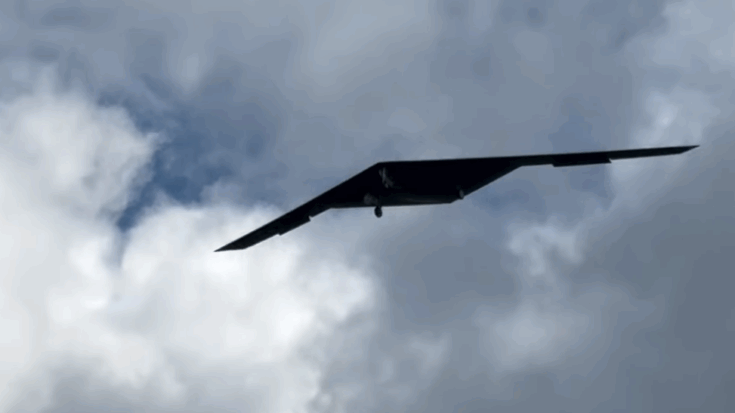
Additional video later surfaced, filmed by aviation enthusiast Efthymios Siakaras, capturing the aircraft from nearly directly below as it approached landing. This angle allowed analysts to study structural details never before visible in open-source imagery. The landing gear arrangement alone confirmed that the aircraft differed from both the B-2 and the newer B-21 Raider, reinforcing long-standing assumptions that it represented a separate classified design.
Equally important was the appearance of a large, transparent section beneath the fuselage. Specialists believe this feature houses advanced sensors used for intelligence gathering. Modern reconnaissance aircraft commonly combine visible-light cameras, infrared imaging systems, synthetic aperture radar, and signals intelligence receivers. Such equipment allows surveillance through darkness, cloud cover, or electronic interference, capabilities increasingly central to modern military planning since the late Cold War era.
Understanding the Aircraft’s Design
The videos also revealed moving control surfaces along the wings and rear fuselage. Observers noted flaperons similar to those used on flying-wing aircraft, along with a rear control feature resembling the gust load alleviation systems installed on earlier stealth bombers. These systems help stabilize aircraft during turbulence while maintaining aerodynamic efficiency, an important consideration for long-duration surveillance missions conducted at high altitude.
Though the aircraft’s official designation remains undisclosed, researchers commonly refer to it as the RQ-180, a name first circulated within defense reporting circles years ago. Aviation historian Peter Merlin has documented evidence suggesting at least nine early production examples existed during developmental stages, with additional operational airframes likely produced later. Differences in paint schemes hinted at in mission insignia suggest experimentation with visibility reduction under varying atmospheric conditions.
View this post on Instagram
Larissa’s Growing Importance
Dates attached to the recordings indicate repeated activity over Larissa during March and early April 2026. Changes in weather conditions across separate videos imply multiple arrivals rather than a single visit. This pattern has strengthened speculation that the Greek base serves as a forward operating location rather than a temporary diversion site.
Transport aircraft movements support this theory. Several C-17 flights traveled between Edwards Air Force Base in California and Larissa, including one recorded in early April under the callsign REACH 1844. Edwards lies close to Plant 42 in Palmdale, historically associated with advanced aerospace development programs. Such logistical links often signal deployment of specialized equipment or personnel supporting classified aviation activities.
Strategic Context and Future Questions
Satellite imagery has revealed two isolated hangars constructed at Larissa within recent years, positioned away from more visible sections of the airfield. Unlike nearby MQ-9 Reaper operations, which use northern facilities, these structures appear designed for discreet handling of sensitive aircraft. Their placement reflects long-standing practices in managing reconnaissance platforms whose missions depend on secrecy as much as technological advantage.
Before these sightings, analysts believed European operations would likely center on RAF Akrotiri in Cyprus or Naval Air Station Sigonella in Sicily. Larissa’s inland position, however, may offer operational flexibility for missions connected to regions surrounding the Black Sea or the Middle East. Strict local restrictions on aircraft photography further reduce unwanted exposure, making Greece an attractive staging location for discreet deployments.
The RQ-180 is widely believed to have operated quietly for years, gathering intelligence far from public attention. As stealth aircraft designs become more common and resemble one another more closely, distinguishing between programs grows harder. With the B-21 Raider approaching broader service, similarities in shape may continue to obscure the drone’s presence, leaving observers wondering what future aircraft might already be under development beyond public awareness.