

Watch: Super Hornet Narrowly Avoids Missile After Suspected Iranian MANPADS Fired
@clashreport / X
Modern air combat often unfolds far from public view, but occasional videos offer rare insight into how dangerous low-altitude missions can be. Footage shared online in late March 2026 appears to show a U.S. Navy F/A-18 Super Hornet narrowly avoiding a missile while operating near the Iranian port city of Chabahar. The incident quickly drew attention from analysts, officials, and online investigators trying to understand what happened during the encounter.
The videos, which surfaced on March 26 and were reportedly recorded a day earlier, capture a fast-moving engagement involving a suspected man-portable air-defense system, commonly known as a MANPADS. These shoulder-launched weapons are designed to target aircraft flying at low altitude, making them especially dangerous during close air support missions.
Footage Shows Missile Passing Behind Aircraft
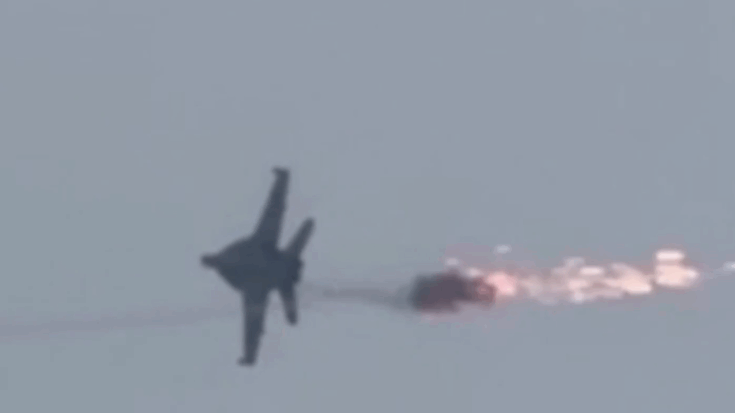
According to visual analysis of several clips filmed from different angles, the Super Hornet was performing a strafing run using its internally mounted M61 20 mm cannon. Exhaust gases from the cannon fire are visible before the aircraft begins a left turn, a maneuver commonly used by pilots after completing an attack pass to exit the target area safely.
Moments later, a missile appears in the footage, trailing a visible flame as it approaches the aircraft from behind. The weapon detonates shortly after, producing an explosion that sends fragments outward while the jet continues flying. No countermeasures such as flares or chaff are visible, leaving unclear whether the crew detected the incoming threat before detonation.
Analysts reviewing the footage noted that the explosion pattern suggests a near miss rather than a direct strike. The elongated flame seen along the missile’s path indicates the blast occurred behind the aircraft. A direct hit would likely have produced a wider fireball centered on the jet itself. Differences in camera zoom and viewing angles initially caused confusion, but comparisons between multiple recordings support the near-miss assessment.
Conflicting Claims and Official Responses
Shortly after the videos spread online, Iran’s Islamic Revolutionary Guard Corps released a statement claiming the aircraft had been successfully struck and later crashed into the Indian Ocean. The statement, published by Fars News Agency, declared: “The enemy F-18 fighter jet was accurately hit in the sky of Chabahar by missiles from the IRGC Navy’s advanced modern air defense system, under the command of the country’s integrated air defense network, and crashed in the Indian Ocean.”
U.S. Central Command responded publicly, stating that the claim was false and adding that no American fighter aircraft had been shot down by Iran. Observers noted that the wording addressed the loss of an aircraft rather than confirming whether damage occurred, leading to speculation online. Without independent confirmation or official damage reports, the condition of the aircraft after the incident remains unknown.
Low-Altitude Operations Increase Risk
The appearance of the footage follows earlier videos showing Super Hornets flying at low altitude over Iranian territory during ongoing operations linked to Operation Epic Fury, which began in late February 2026. Early mission releases indicated that U.S. aircraft mainly relied on stand-off weapons launched from safer distances. More recent activity suggests aircraft have moved closer to targets as defenses were reduced.
Low-level attack runs allow pilots to strike targets with greater precision but also expose aircraft to hidden threats. Larger air-defense systems can often be detected and targeted beforehand, while MANPADS remain difficult to locate due to their small size and mobility. Operators can conceal them easily, creating sudden danger even in areas considered relatively secure.
Reports connected to the same period also described an emergency landing involving a U.S. F-35 after a combat mission, with claims that the aircraft may have suffered damage from ground fire. Officials did not confirm those details, though sources suggested the pilot landed safely despite possible shrapnel impact.
The near miss involving the Super Hornet illustrates how handheld air-defense weapons continue to influence modern aerial warfare, forcing pilots to balance mission effectiveness with constant exposure to unpredictable threats near the battlefield.






