

WWII Footage: 1944 USAAF Gun Camera Films Show Fighter Kills Over Europe
ZenosWarbirds / YouTube
During the closing stages of the Second World War, aerial combat entered a new and unfamiliar phase. Traditional piston-engine fighters still dominated the skies, yet experimental aircraft and evolving tactics began to reshape how air power was used. Film footage from this period, often captured through gun-mounted cameras, provides a rare and direct view of these changes as they unfolded in combat.
One of the most striking developments was the introduction of jet propulsion by German engineers. These aircraft represented a significant technological shift, even if their impact on the war remained limited by production shortages and operational challenges. Allied pilots quickly encountered these machines and had to adapt their tactics to meet a new kind of threat.
The Arrival of Jet-Powered Fighters
Among the earliest operational jet fighters was the Messerschmitt Me 262, a twin-engine aircraft that differed sharply from earlier designs. Its engines relied on compressed air mixed with fuel, creating thrust through expanding gases rather than traditional propellers. This allowed it to reach speeds near 500 miles per hour at altitude, making it faster than most Allied fighters of the time.
Despite its speed, the aircraft had weaknesses. It required wide turns and was less agile in close combat. Allied pilots soon learned that while it could outrun them, it could also be outmaneuvered. Armed with four 30 mm cannons mounted in its nose, the Me 262 carried considerable firepower, though its effectiveness depended heavily on pilot skill and tactical conditions.
Rocket Flight and Extreme Performance
Even more unusual was the Messerschmitt Me 163 Komet, a rocket-powered interceptor. Unlike jet aircraft, it carried its own oxygen supply, allowing it to operate at very high altitudes without relying on atmospheric air. Its short, swept wings and compact shape gave it a distinctive appearance and remarkable climb rate.
However, this performance came at a cost. The aircraft had a very limited flight time and was difficult to handle, particularly during landing. While it could intercept bombers quickly, it was vulnerable once its fuel was exhausted. As a result, it never became a decisive factor in the air war.
Gun Camera Evidence and Air Combat Reality
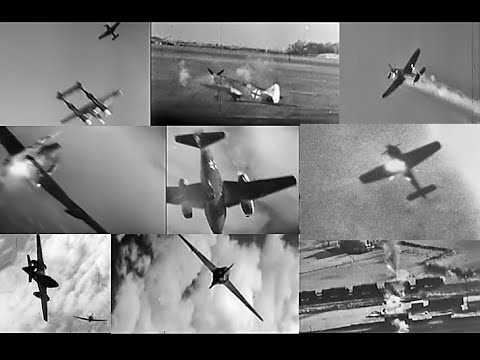
Gun camera footage from Allied aircraft offers valuable insight into how these encounters played out. These cameras, synchronized with the aircraft’s weapons, recorded both successful strikes and missed opportunities. They reveal how quickly engagements unfolded and how pilots relied on precise aiming and timing.
Footage shows German aircraft being attacked during flight, takeoff, and even while parked on airfields. Fighters such as the Focke-Wulf Fw 190 and Messerschmitt Bf 109 appear frequently, reflecting their widespread use. Allied pilots often described favorable firing positions as “easy setups,” though success still depended on skill under pressure.
Expanding Roles of Fighter-Bombers
As the war progressed, Allied air forces placed greater emphasis on ground attack missions. Aircraft like the A-36 Apache were used to strike transportation networks, bridges, and supply routes. These missions aimed to weaken German forces by disrupting movement and logistics.
Operations over Italy illustrate this approach clearly. Pilots targeted highways, rail lines, and bridges linking key cities such as Rome and Cassino. Flying at low altitudes, they attacked convoys and infrastructure with bombs and machine gun fire. Such missions required careful navigation and exposed pilots to ground defenses, but they played an important role in supporting advancing Allied troops.
Tactical Flexibility in Late-War Air Operations
The combination of air-to-air combat and ground attack missions demonstrated the growing versatility of Allied air forces. Pilots shifted between roles depending on operational needs, using both speed and precision to achieve their objectives. These tactics reflected a broader strategy that combined technological adaptation with coordinated planning across air and ground units.
Gun camera recordings from this period continue to serve as important historical evidence, showing not only the destruction of enemy equipment but also the changing nature of aerial warfare during one of the most intense periods in aviation history.






